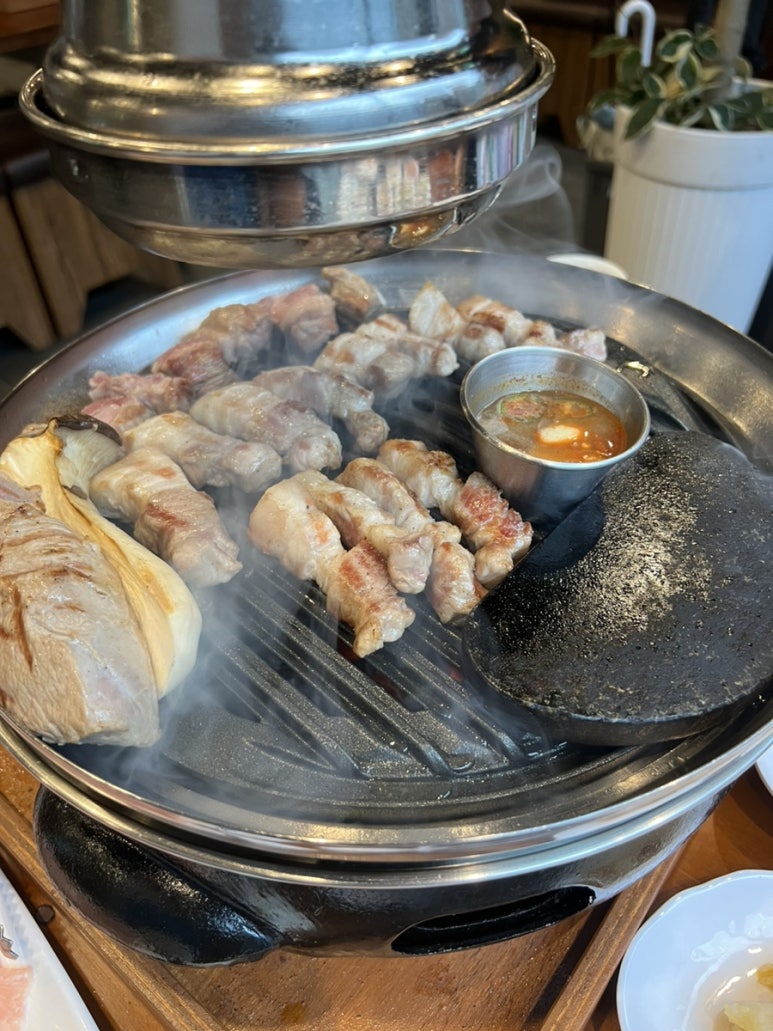
If you have watched a Korean drama and wondered what those groups of coworkers are eating around a smoking iron grill, the answer is almost certainly samgyeopsal (sam-gyeop-sal, 삼겹살) — thick-cut pork belly, grilled tableside, wrapped in lettuce and eaten with at least two shots of soju. Samgyeopsal is not simply a meal in Korea. It is a ritual: the unwinding of a long workday, a reason to gather, and one of the few foods that transcends age, income, and social class. Unlike the broader Korean BBQ experience — which covers beef, chicken, and various cuts — samgyeopsal is singular in its focus and its cultural weight. Understanding it means understanding something core about how Koreans eat together.
Types of Samgyeopsal You Need to Know
Classic Pork Belly (생삼겹살)
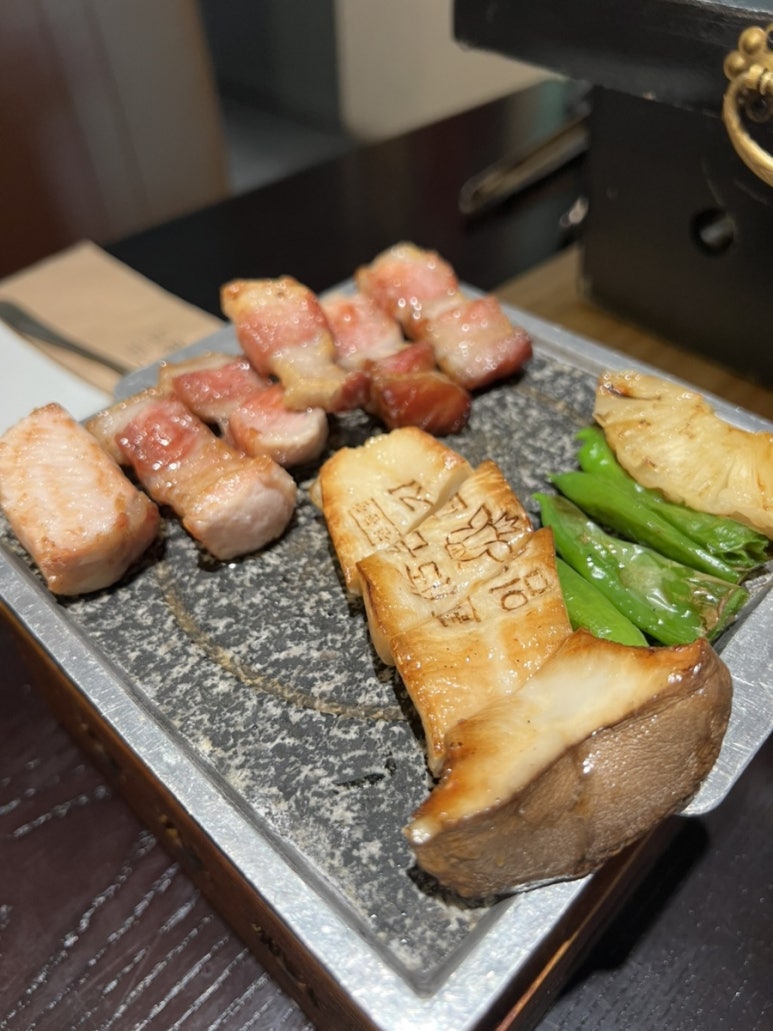
Saeng samgyeopsal (saeng-sam-gyeop-sal, 생삼겹살) is the baseline: thick slabs of fresh, unmarinated pork belly placed directly on a gas or charcoal grill. The fat renders slowly, crisping the underside while keeping the interior juicy. This is the version you will find at the vast majority of Korean BBQ restaurants and the one most commonly shown in K-dramas.
Charcoal Grilled Pork Belly (숯불삼겹살)
Sutbul samgyeopsal (sut-bul-sam-gyeop-sal, 숯불삼겹살) uses real charcoal instead of gas, producing a slightly smoky, more intensely caramelised result. The heat is harder to control, so these restaurants tend to be slightly more expensive and are often considered the premium version. If a restaurant advertises sutbul, it is worth the extra cost.
Iron Lid Pork Belly (솥뚜껑삼겹살)
Sottukkung samgyeopsal (sot-ttu-kkung-sam-gyeop-sal, 솥뚜껑삼겹살) is grilled on a convex iron lid — literally a pot cover repurposed as a cooking surface. The dome shape lets excess fat drain away from the meat while keeping the surface extremely hot. The result is crispier than flat-grill versions, with almost crackled edges. This style is popular in the countryside and is gaining ground in Seoul as a slightly nostalgic, rustic presentation.
Shaved Pork Belly (대패삼겹살)
Daepae samgyeopsal (dae-pae-sam-gyeop-sal, 대패삼겹살) is pork belly sliced paper-thin with a deli slicer — daepae means carpenter's plane, which describes the cut exactly. These thin sheets cook in seconds, curl immediately on the hot grill, and have a different texture from the thick-cut version: more crisp, less chewy, and eaten in rapid succession. Daepae restaurants are usually slightly cheaper and are popular with younger diners who want speed and volume.
Marinated Pork Belly (양념삼겹살)
Yangnyeom samgyeopsal (yang-nyeom-sam-gyeop-sal, 양념삼겹살) comes pre-marinated in a paste of soy sauce, garlic, gochujang, and sesame oil. The marinade caramelises quickly on the grill, so watch carefully — it burns faster than plain pork belly. The flavour is bolder and sweeter than the unmarinated version.
How to Order and Eat Samgyeopsal
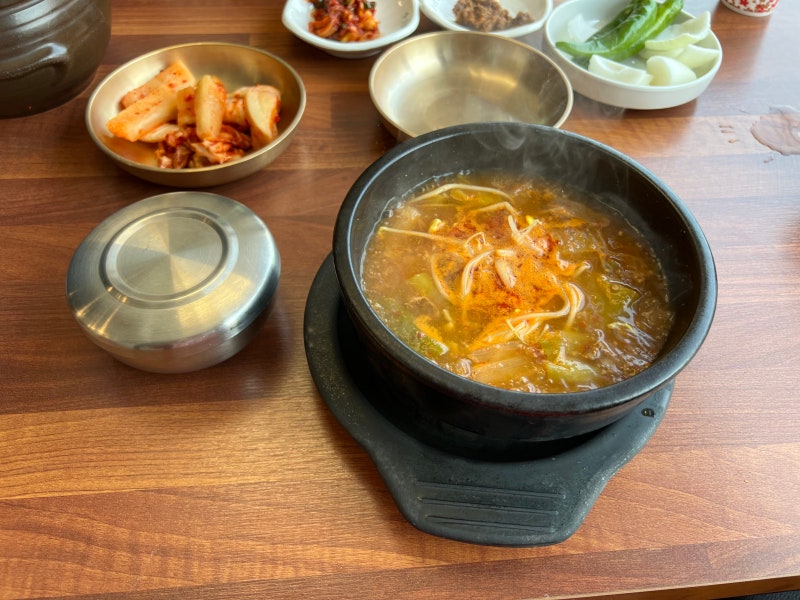
Samgyeopsal is ordered by the portion (inbun, 인분), with each restaurant setting a minimum — usually two portions per visit. The server will bring a set of banchan (side dishes): typically kimchi, sliced garlic and green chilli, dipping sauces (ssamjang and sesame oil with salt), and often a small bowl of doenjang jjigae (된장찌개, fermented soybean paste stew).
The grill will be lit at your table. At many restaurants the server will do the first round of cutting and flipping; at others you manage the grill yourself. Use the scissors — every table has them — to cut the pork into bite-sized pieces once it is mostly cooked. The correct eating sequence goes like this:
- Take a piece of ssam (쌈) — lettuce or perilla leaf — in your palm
- Add a piece of grilled pork, a smear of ssamjang (쌈장, fermented chilli-soybean paste), a slice of raw garlic, and a sliver of green chilli
- Fold the entire thing into a parcel and eat it in one bite
- Chase with soju, beer, or somaek (소맥, soju and beer mixed)
The doenjang jjigae that arrives alongside is not an afterthought — Koreans use it to reset the palate between bites and to round out the fat of the pork. Do not skip it.
Toward the end of the meal, many diners ask for a small portion of kimchi bokkeumbap (김치볶음밥, kimchi fried rice) cooked directly on the same grill using the leftover pork fat. This step is optional but widely considered the best part of the meal.
Samgyeopsal and Soju: The Non-Negotiable Pairing
Samgyeopsal and soju (소주) are served together so consistently that the combination has its own cultural shorthand in Korea — ordering one without the other raises eyebrows. The logic is practical: soju's clean, slightly sweet flavour cuts through the richness of the pork fat, and the ritual of pouring soju for each other reinforces the social dimension of the meal. If you prefer not to drink alcohol, bokbunja (복분자, black raspberry wine) or sparkling water with a squeeze of lemon are acceptable substitutes.
Where to Find Samgyeopsal in Seoul
Samgyeopsal restaurants exist on nearly every block in Seoul, but the best experiences tend to cluster in a few areas. Mapo-gu (마포구) — covering Hongdae, Hapjeong, and Sangam — has a particularly dense concentration of well-run samgyeopsal restaurants popular with university students and young professionals. Jung-gu (중구), centred on Euljiro and Myeongdong, offers options that cater to both office workers and tourists. Seocho-gu (서초구) near Gangnam has upmarket versions of the same format at slightly higher prices.
For a more local experience, look for restaurants that display their pork belly raw in a refrigerated glass case at the entrance — this signals fresh, daily-sourced meat. Avoid restaurants that do not show the meat before cooking. A good samgyeopsal restaurant will also change the grill grate frequently throughout the meal so the meat does not pick up a burnt flavour.
You can find recommended samgyeopsal spots across Seoul via the Korea transportation guide to plan your route between neighbourhoods.
Price Guide
- ₩12,000–16,000 per portion (200g) at neighbourhood restaurants
- ₩16,000–22,000 per portion at charcoal grill restaurants or premium cuts
- ₩8,000–12,000 per portion for daepae (shaved) versions at budget spots
- Side dishes (banchan) and doenjang jjigae are included at no extra charge
- Soju is typically ₩4,000–6,000 per bottle (360ml)
- A full dinner for two with soju: expect ₩35,000–55,000 total
Tips for First-Timers
- Go with at least two people. Most restaurants require a minimum order of two portions and the experience is designed for sharing. Solo diners will find it easier at daepae restaurants, which are more accustomed to single orders.
- Let the server manage the grill at first. If you are unsure when to flip, watch what the server does on the first round and replicate it. Pork belly is ready to flip when the edges go from pink to white and fat starts pooling on the surface.
- Ask for fresh grates. It is completely acceptable to ask staff to change the grill grate mid-meal. Say 석쇠 교체해 주세요 (seok-soe gyo-chae-hae ju-se-yo) — "please change the grill grate."
- Expect smoke. Samgyeopsal restaurants are smoky by nature. Avoid wearing clothes you are precious about, and use the coat hooks near the entrance if available.
- Check if the restaurant is BYOB. A small number of samgyeopsal restaurants near convenience stores let you bring your own alcohol — look for a sign saying 주류 반입 가능 (alcohol allowed).
- Dinner is the prime time. While samgyeopsal is available at lunch, the atmosphere — the noise, the packed tables, the clinking of soju glasses — is at its best from 6 PM onward on weekdays and from 5 PM on weekends.