There is a line in Korean popular culture so widely understood it has become a national meme: "라면 먹고 갈래요?" — "Do you want to come in for ramyeon?" Everyone in Korea knows this is not really about noodles. But the fact that ramyeon (ra-myeon, 라면) was chosen as the vehicle for this particular euphemism says everything about its place in Korean life. Ramyeon is cheap, available at all hours, cooked in minutes, and eaten in every conceivable setting — alone in a convenience store at midnight, on a Han River bench with a gas burner, in a university canteen, or at a proper sit-down restaurant. If K-dramas have taught you one thing about Korean food, it is probably ramyeon. This guide covers every version: instant, restaurant, and the Japanese-influenced ramen that has carved out its own lane in Seoul.
Korean Ramyeon vs Japanese Ramen: Know the Difference
The two words sound similar and both describe noodle soup, but they are distinct eating experiences. Korean ramyeon (라면) uses a thin, wavy, wheat noodle in a bright red, MSG-forward broth. It is fast food by design — cooked in three minutes, bold and spicy, meant to be slurped quickly. Japanese ramen (라멘) uses a different noodle profile and a slow-cooked broth — tonkotsu, shoyu, miso, or shio — that takes hours to prepare. In Seoul you will find both, sometimes in the same neighbourhood, and increasingly a hybrid version: Korean-owned shops with Japanese ramen technique but Korean spice levels.
When you see ramyeon (라면) on a Korean restaurant menu, you are ordering the Korean style. When you see ramen (라멘) written in hangul or Roman script, the restaurant is signalling a Japanese-style approach. Do not assume they are the same.
The Three Worlds of Korean Ramyeon
1. Instant Ramyeon (인스턴트 라면)
Korea produces some of the world's most consumed instant noodles. Shin Ramyun (신라면) by Nongshim is the global benchmark — spicy beef broth, firm noodles, dried vegetable flakes. Buldak Bokkeummyeon (불닭볶음면, literally "fire chicken stir-fried noodles") became an international sensation through spice-challenge videos and is genuinely difficult to finish without breaking a sweat. Knowing the major brands and their heat levels is useful before you start ordering.
- Shin Ramyun (신라면) — The national standard. Medium spicy, beef-based, deeply savoury. Spice level: 3/5.
- Buldak Bokkeummyeon (불닭볶음면) — Dry noodles tossed in a thick, fiery sauce. No broth. Spice level: 5/5 (original); 4/5 (carbonara version).
- Yukgaejang Ramyeon (육개장 라면) — Based on the spicy beef and vegetable soup. Earthier and more complex than Shin Ramyun. Spice level: 3.5/5.
- Neoguri (너구리) — Seafood-based, udon-style thick noodles with a softer spice profile. Good entry point for spice beginners. Spice level: 2/5.
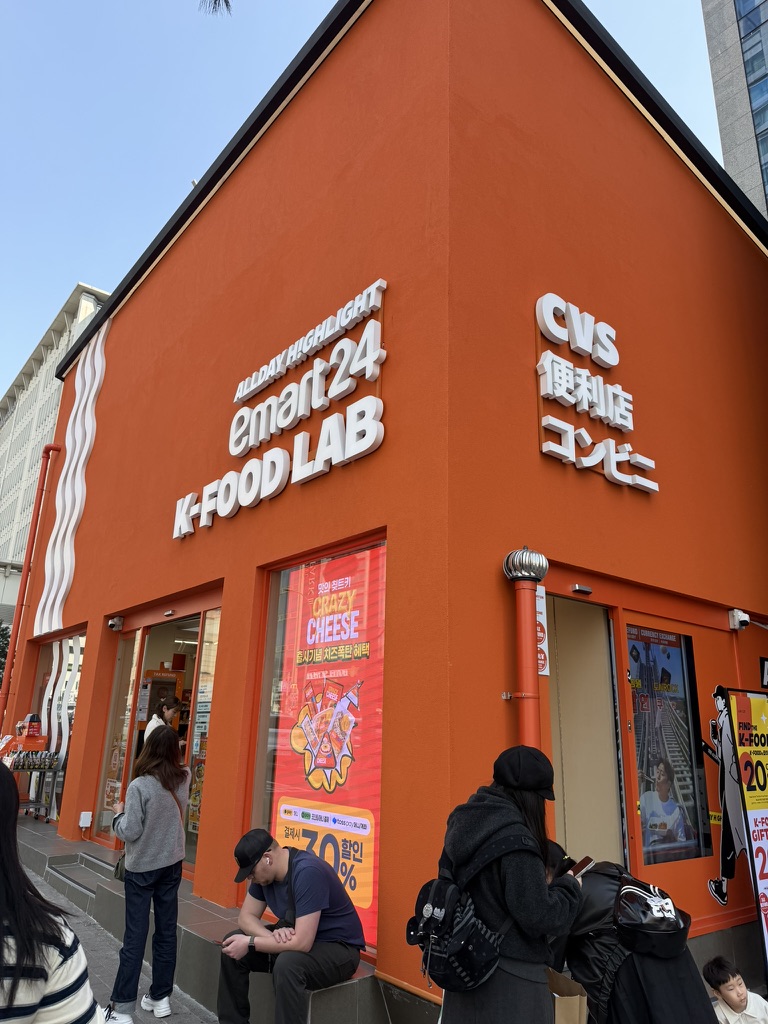
Convenience stores (GS25, CU, 7-Eleven, Emart24) sell instant ramyeon and provide hot water stations, small gas burners, and sometimes dedicated ramyeon stations with boiling water on tap. Eating instant ramyeon in a convenience store is a legitimate and popular option, not a budget compromise.
2. Restaurant Ramyeon (식당 라면)
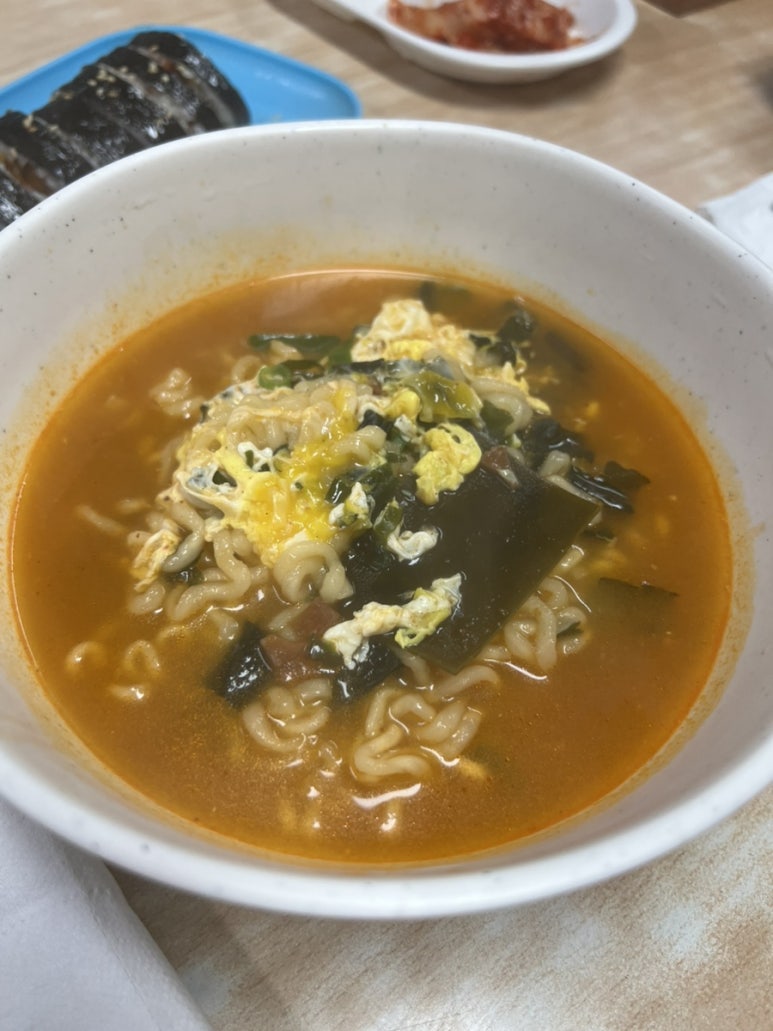
Korean bunsik (분식) restaurants — the category covering cheap, fast Korean comfort food — serve ramyeon as a full sit-down dish. The noodles are the same brand you buy at a convenience store, but the restaurant versions add: a raw egg cracked in at the end, extra toppings like rice cakes (tteok, 떡) or dumplings (mandu, 만두), and a proper stainless steel pot with a lid that keeps everything boiling at the table. This is considered more satisfying than the cup version.
Tteok-ramyeon (떡라면) adds chewy rice cakes. Mandu-ramyeon (만두라면) adds dumplings. Cheese ramyeon (치즈라면) places a processed cheese slice on top, which melts into the broth and softens the spice. All are acceptable choices and all are cheap — typically ₩4,000–7,000.
3. Specialty Ramyeon Restaurants (전문 라면집)
Teumsae Ramyeon (teum-sae ra-myeon, 틈새라면) is the best-known chain in this category. Founded in Sinchon in the 1980s, Teumsae built its reputation on bibimseu ramyeon (비빔스 라면) — a stir-fried, dry ramyeon with a sauce of gochujang and garlic that produces a heat level several notches above standard instant noodles. The brand offers a spice scale and the highest levels are taken seriously as a challenge. Teumsae Sinlim branch is one of the most frequented locations in Seoul.
How to Order Ramyeon at a Korean Restaurant
Ordering ramyeon at a Korean restaurant is one of the simpler experiences in Korean dining — menus are usually short, prices are displayed clearly, and most restaurants have picture menus.
- Ask about spice levels (maepgi, 맵기). Many restaurants offer mild (순한 맛), standard (보통), or extra spicy (매운 맛). Always confirm before ordering if you are unsure.
- Add-ons (사리, sari). Extra noodles, rice cakes, dumplings, or a raw egg can be added to any ramyeon order, usually for ₩500–1,500 each. Say 계란 사리 추가해 주세요 (gyeran sari chu-ga-hae ju-se-yo) for an extra egg.
- Rice on the side (공기밥, gong-gi-bap). Many Koreans eat ramyeon with plain steamed rice on the side. It costs around ₩1,000 and is always available. The combination of spicy broth poured over rice is a widely used finishing move.
- Do not pour the whole packet in. At restaurants where you make your own ramyeon at the table (some bunsik spots), use only half the seasoning packet if you are spice-sensitive and add more gradually.
Where to Find Ramyeon in Seoul
Ramyeon restaurants are most densely concentrated around university campuses — Sinchon (신촌), Hongdae (홍대), Anam (안암, near Korea University), and Nowon (노원, near Sahmyook University) all have strong bunsik and ramyeon restaurant clusters. These areas are the cheapest and most authentic for the sit-down restaurant version.
For Japanese-style ramen in Seoul, Jongno (종로) and the area around Euljiro (을지로) have seen a wave of ramen specialist openings in the last five years. Itaewon (이태원) and Hannam-dong (한남동) also carry several well-regarded ramen shops catering to international tastes.
Han River ramyeon — cooking instant noodles in a rented gas burner set on the riverbank — is a separate Seoul experience covered in the Han River ramen guide. The two experiences are complementary, not interchangeable.
Price Guide
- ₩1,500–2,500 — Instant ramyeon from a convenience store (cup or bag)
- ₩4,000–7,000 — Restaurant ramyeon at a bunsik or casual Korean diner
- ₩7,000–10,000 — Specialty ramyeon restaurants (Teumsae and similar)
- ₩10,000–15,000 — Japanese-style ramen restaurants in Seoul
- ₩1,500–3,000 — Han River convenience store ramyeon kit (noodles + gas burner rental)
Tips for First-Timers
- Start with Shin Ramyun before Buldak. If you are not accustomed to Korean spice levels, order Shin Ramyun first to calibrate. Buldak Bokkeummyeon at full strength has hospitalised overconfident tourists.
- The drama line is real but context-dependent. "라면 먹고 갈래요?" (Do you want ramyeon?) is used genuinely as an invitation for food and also as a social code. In a restaurant context, just order the noodles.
- Do not slurp loudly. Despite what you may have heard, Koreans do not slurp as noisily as Japanese ramen culture. Moderate slurping is fine; theatrical noise is not.
- Cheese is not a strange topping. Processed cheese slices on ramyeon are widely eaten and genuinely improve the experience by cutting heat. Try it before judging.
- Leftover broth over rice. If you cannot finish your ramyeon, ask for a small bowl of plain rice and pour the remaining broth over it. Add sesame seeds if available. This is what Koreans do.