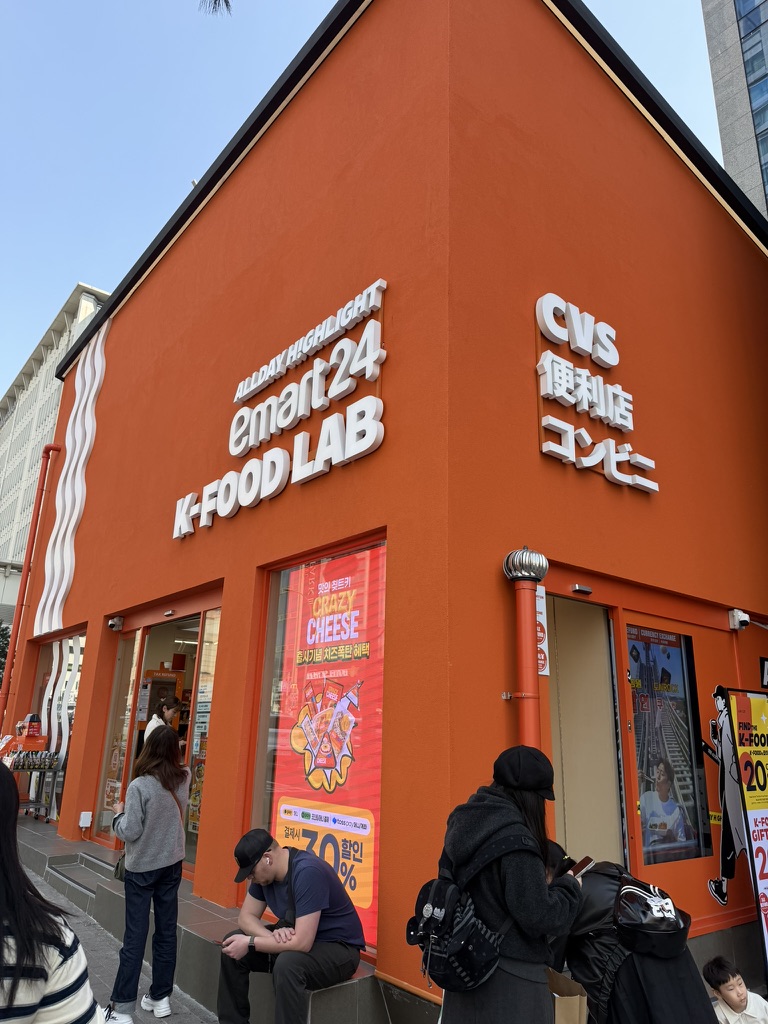
In most countries, a convenience store is a place you visit out of desperation — overpriced, underwhelming, and forgettable. Korean convenience stores (pyeonuijeom, 편의점) are the exact opposite. With over 50,000 locations nationwide — more per capita than almost anywhere on earth — chains like GS25, CU, 7-Eleven, and emart24 have turned the humble convenience store into a legitimate food destination. Hot food counters, self-service microwaves, fresh triangle kimbap restocked every few hours, soft-serve machines, and rotating seasonal collaborations with K-pop idols: the Korean convenience store is part canteen, part snack museum, and part cultural institution. Whether you're grabbing a ₩1,200 triangle kimbap at 3am or joining the daily queue for CU's sold-out Yonsei cream bread, this guide covers everything you need to know.
The Big 4: Korea's Convenience Store Chains
GS25
With approximately 17,000 locations across Korea, GS25 is one of the two market leaders alongside CU. GS25 is the chain most associated with K-pop collaborations — limited-edition packaging with idol groups appears constantly, making it a pilgrimage stop for fans. GS25 also launches new products at the highest volume of any chain, which means it's often the first place to find viral food trends. Their private-brand line YouUs (유어스) covers everything from yogurt drinks to instant noodles. GS25 is also known for its premium hyeja dosirak (혜자도시락) lunchboxes — the name is a cultural shorthand for outstanding value, referencing a beloved TV personality known for generosity.
CU
CU matches GS25 in store count (~17,000) and consistently wins loyalty polls for food quality. Its single most famous product is the Yonsei Milk Cream Bread (연세우유 생크림빵) — a collaboration with Yonsei University Dairy that caused nationwide sellouts and long morning queues when it launched. CU is also known for strong lunchbox offerings and exclusive ramen flavours. In 2025 CU opened its first international store in Hawaii, a sign of how seriously the chain takes its global profile. If you only visit one chain during your trip, CU is the most consistent across all food categories.
7-Eleven
Korea's 7-Eleven (~11,000 locations) leans into premium positioning. Its in-store café counters serve espresso-based drinks that rival standalone coffee shops, and it holds exclusive distribution on popular snacks like HBAF Cheese Popcorn. 7-Eleven tends to have slightly fewer hot food options than GS25 or CU but compensates with a stronger drink selection and a calmer, less hectic in-store experience. It's a good choice for coffee and a snack between sightseeing stops.
emart24
The smallest of the big four (~6,500 locations), emart24 is owned by the Shinsegae group and has the most premium identity. The chain sells wine and craft beer more prominently than competitors, stocks thicker premium sandwiches and katsu-style snacks, and regularly collaborates with Starbucks Korea on exclusive drinks. If you're looking for something slightly more elevated than the standard convenience store spread — or just want a decent bottle of wine to take to Han River — emart24 is your stop.
Top 20 Must-Try Foods
Every item below is available at most major chains unless noted. Prices vary slightly by location and season.
-
Triangle Kimbap (삼각김밥) — ₩1,200–1,800
The undisputed icon of Korean convenience store food. A triangular rice ball wrapped in seaweed with a filling sealed inside — pull the numbered tabs in sequence to separate the crispy seaweed from the rice just before eating (the instructions are printed on the wrapper). Fillings include tuna mayo (chamchi mayo, 참치마요), bulgogi beef, spicy pork, kimchi, and seasonal specials. Restocked multiple times per day. Buy two — one is never enough. -
Cup Ramen (컵라면) — ₩1,200–2,000
Korea produces some of the world's best instant ramen, and the convenience store cup selection runs to dozens of varieties. Shin Ramyun (신라면) is the benchmark — deeply savoury, genuinely spicy, and globally recognised. Buldak Bokkeummyeon (불닭볶음면) is the viral fire-noodle challenge staple. Samyang Kimchi Ramen and Ottogi Jin Ramyun round out the classics. Use the free hot water dispenser next to the register, wait three minutes, and eat standing at the counter like a local. -
Lunchbox / Dosirak (도시락) — ₩3,500–6,700
Ready-to-eat meal boxes with rice, a main protein (bulgogi, chicken, or pork cutlet), and 2–3 side dishes. Microwave for two minutes in the store's free microwave. The quality has improved dramatically over the past decade — a ₩5,000 dosirak from GS25 or CU is a genuinely satisfying meal. Look for limited-edition celebrity collaboration boxes, which sell out fast. -
Spicy Rice Cakes (떡볶이) — ₩2,000–3,500
Tteokbokki (떡볶이) is Korea's most beloved street food, and convenience stores have brought it indoors. The hot food counter version is sold in a paper cup with a skewer — gochujang-based sauce, chewy rice cakes, fish cake slices. Variants include cheese tteokbokki (치즈 떡볶이) and rosé tteokbokki (로제 떡볶이) for a creamier, less spicy profile. Eat immediately while hot. -
Fish Cake Skewer (오뎅꼬치) — ₩500–1,200
Odeng (오뎅) skewers sit in a pot of simmering broth next to the hot food counter. Pick a skewer, pay at the register, and help yourself to a cup of the free broth on the side — odeng guk (오뎅국) is the complimentary soup that comes with every skewer purchase. It's salty, warming, and one of the best free things in Korea. A winter staple, though available year-round. -
Corn Dog / Hot Dog (핫도그) — ₩1,500–2,500
The Korean corn dog has evolved far beyond the American original. Varieties include the classic battered sausage, the cheese corn dog (치즈 핫도그) with a molten mozzarella core, and the potato corn dog (감자 핫도그) coated in crispy potato dice. Drizzle with yellow mustard and ketchup from the condiment station. Best eaten fresh from the warmer. -
Fried Chicken (편의점 치킨) — ₩2,000–4,000
Convenience store fried chicken has become serious business. Pieces are kept warm in the hot food display and come in original, spicy, and soy-garlic varieties. While it won't replace a dedicated fried chicken restaurant, it's excellent value as a quick snack or late-night anju (drinking snack) paired with a cold beer. GS25 and CU both carry strong chicken offerings. -
Steamed Bun (호빵) — ₩1,200–1,500
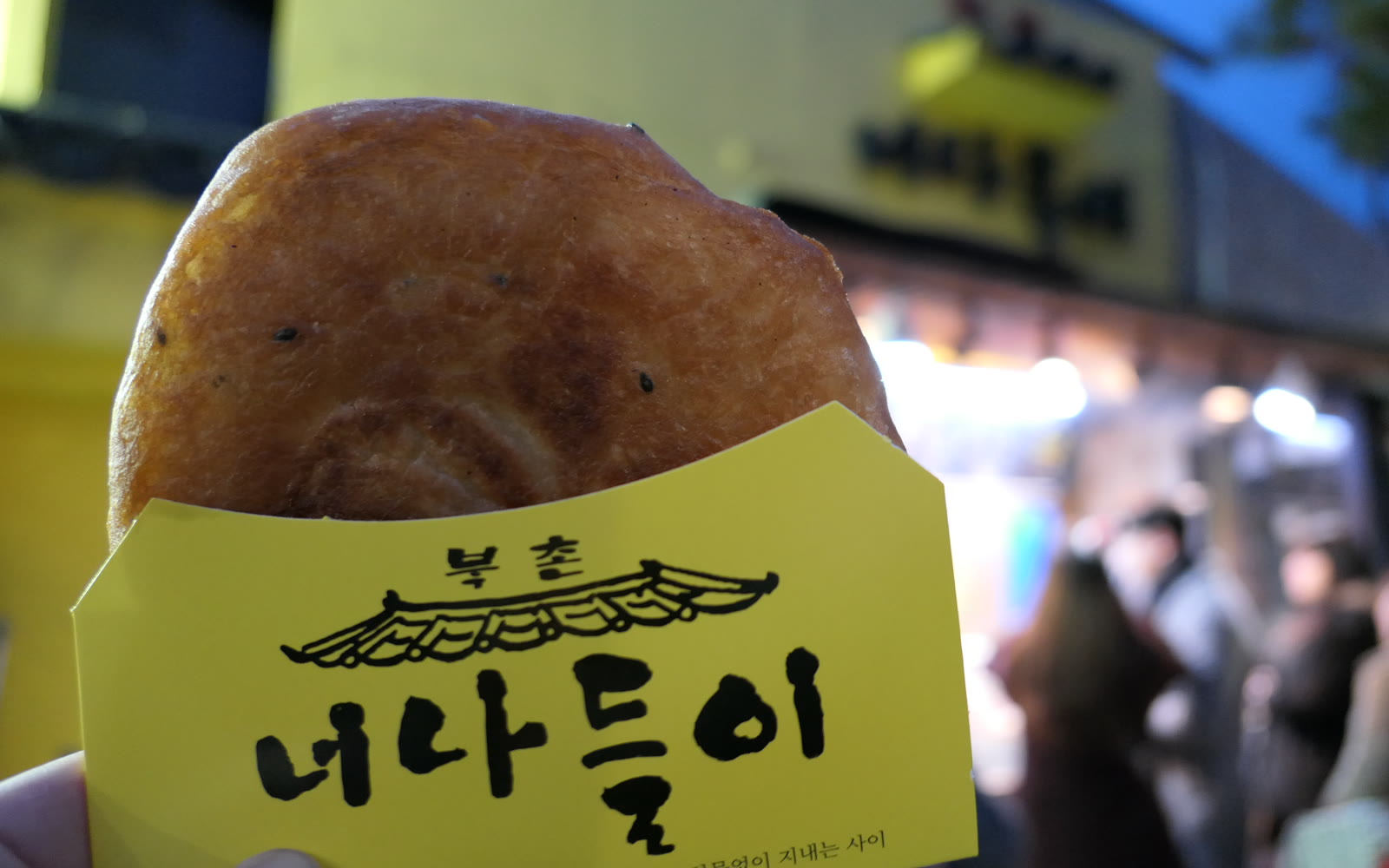
Hobang (호빵) is a large, pillowy steamed bun filled with sweet red bean paste, kept warm in a dedicated steamer on the counter. It's a winter-season staple — the moment hobang appears in stores in October, Koreans know autumn has truly arrived. Flavours have expanded to include pizza, curry, and pizza-cheese, but red bean (pat, 팥) remains the classic. Hold it with the provided paper sleeve; it's hot. -
Bungeo Ice Cream (붕어사만코) — ₩1,000–2,000
Bungeo-ppang (붕어빵) is the fish-shaped waffle pastry filled with red bean paste that's beloved as a winter street food. Bungeo Samanko turns it into an ice cream bar — fish-shaped vanilla ice cream with a red bean core, coated in chocolate. Available year-round in the freezer section and one of the most photogenic items in any convenience store. A genuinely clever and delicious fusion of two Korean classics. -
Yonsei Milk Cream Bread (연세우유 생크림빵) — ₩2,800 (CU exclusive)
The most talked-about convenience store item of recent years. A collaboration between CU and Yonsei University's dairy cooperative, this soft milk bread is filled with a thick, lightly sweetened fresh cream that doesn't use artificial stabilisers — meaning it has a short shelf life and sells out fast. Rotating flavours include original, strawberry, chocolate, and seasonal specials. Arrive before 10am for the best chance of finding one. The queue and the sellouts are part of the experience. -
Buldak Ramen (불닭볶음면) — ₩1,400–2,000
Samyang's fire chicken noodle is no longer just a viral challenge food — it's a legitimate convenience store staple. The original 2x Spicy version (핵불닭) tests everyone's tolerance, but the Carbonara Buldak (까르보나라 불닭) with its creamy white sauce is genuinely delicious and much more approachable. Add a slice of cheese from the refrigerator section and mix it in — this is one of the official modisumer hacks endorsed by the brand itself. -
Banana Milk (바나나맛우유) — ₩1,600–1,800
Binggrae's iconic barrel-shaped banana milk has been a Korean favourite since 1974. It's sweet, creamy, mildly banana-flavoured, and comes in an instantly recognisable stubby plastic container. It consistently ranks as the top-selling item for foreign visitors at CU — partly for the taste and partly because it appears in so many K-dramas and K-pop music videos as a character prop. Strawberry and melon versions are available but the original is non-negotiable. -
Baked Egg (구운계란) — ₩700–1,000
Brown-shelled eggs slow-baked until the whites firm up and the yolks turn slightly creamy, sold individually or in small bags near the hot food counter. They taste like a cross between a boiled egg and a roasted nut — slightly caramelised, deeply savoury. The association with jjimjilbang (찜질방, Korean sauna) culture makes them a nostalgic comfort food for Koreans and a novel discovery for visitors. Cheap, filling, and high-protein. -
Sandwich (샌드위치) — ₩2,500–4,500
Korean convenience store sandwiches use shokupan-style soft white bread and are filled with egg salad, tuna, BLT combinations, or katsu cutlet with tonkatsu sauce. The bread is always fresh-soft (close to the expiry label for the best flavour) and portions are surprisingly generous. The egg salad sandwich (에그마요 샌드위치) is the gateway item — mild, creamy, and almost impossible to dislike. A great breakfast option before an early start. -
Free Fish Cake Soup (어묵국물) — Free with odeng purchase
Not a food item to buy, but the most important free thing in any Korean convenience store. The clear, anchovy-and-kelp-based broth in the odeng pot warmer is available as a complimentary side whenever you purchase a fish cake skewer. Served in a small paper cup, it's salty, umami-rich, and genuinely warming on a cold day. Standing outside a convenience store in winter, eating an odeng skewer and sipping broth, is one of the most quintessentially Korean food experiences available to visitors. -
Melona Ice Cream (메로나) — ₩700–1,000
Binggrae's Melona bar has been a Korean summer staple since 1992. Honeydew melon-flavoured, creamy (it's made with real cream, not just ice), and pastel green — it's one of the most recognisable ice creams in Asia. The original melon flavour remains the classic, but strawberry, banana, and coconut versions are all worth trying. At under ₩1,000, it's one of the best-value items in the freezer. Melona has since gone international but the original Korean version tastes better — creamier and less sweet. -
Sundae (순대) — ₩2,000–3,000
Sundae (순대) is Korean blood sausage — glass noodles, barley, and vegetables stuffed into a pork intestine casing and steamed. It sounds confronting but the flavour is mild, slightly chewy, and deeply savoury. The convenience store version comes in a sealed package for microwave heating (2 minutes) and is served with a dipping packet of ganjang (soy sauce) or saeujeot (salted shrimp paste). It's a staple pojangmacha (street stall) food that's now fully domesticated into the convenience store format. An adventurous and authentic choice. -
Cream Bread (크림빵) — ₩2,000–3,500
Soft white bread filled with custard cream, whipped cream, or flavoured fillings — seasonal rotations mean there's almost always a limited-edition version in stock. Beyond the Yonsei Cream Bread (CU exclusive), most chains carry their own versions year-round. GS25's Wangttong Cream Bread (왕뚜껑 크림빵) is a popular staple. These sell fast in the morning — convenience stores near universities and office districts often sell out by 9am. -
Dubai Chocolate (두바이 초콜릿) — ₩3,000–6,000
The viral 2024–2025 trend that caused genuine queuing panic in Korean convenience stores. Inspired by the pistachio-and-kataifi-pastry Dubai chocolate that went viral on social media, Korean confectionery brands launched their own versions — first at premium prices, then rapidly democratised into the convenience store price range. The filling combines crunchy shredded wheat pastry (kadaif) with pistachio cream inside a milk or dark chocolate shell. GS25 and CU both carried major versions. Availability varies — check the snack shelf near the register. -
Flavoured Milk (맛있는우유) — ₩1,200–1,800
Korea's flavoured milk category is enormous. Beyond banana milk, the refrigerator section carries chocolate milk (choco-maelkeu, 초코맛우유), strawberry milk (ttalgi-maelkeu, 딸기맛우유), coffee milk (keopi-maelkeu, 커피맛우유), and sweet black sesame milk. Seoul Milk and Binggrae are the dominant brands. These are genuine daily staples for Korean school children and office workers — fresh, lightly sweetened, and far superior to UHT international equivalents. The coffee milk, in particular, is an excellent morning pick-up.
Best Food Combos (Modisumer Style)
Modisumer (모디슈머) is the Korean portmanteau of "modify" and "consumer" — the culture of hacking convenience store products into new combinations that the manufacturers never intended. Many modisumer combos have become so popular that the brands now officially endorse them. Here are the best ones to try:
- Classic Ramen + Triangle Kimbap (~₩3,000) — The foundational convenience store meal. Cup ramen (Shin Ramyun recommended) plus one or two triangle kimbap. Eat the kimbap between ramen slurps to moderate the spice. This combination is eaten by millions of Koreans every single day and is greater than the sum of its parts.
- Omori Kimchi Jjigae Ramen + Sausage + Soft-Boiled Egg (~₩4,000) — The upgraded meal set. Omori's kimchi stew ramen is rich and deep-flavoured; add a cocktail sausage from the hot food counter and a convenience store soft-boiled egg (bansucan, 반숙란) for protein. The egg yolk breaks into the broth and creates a luxurious texture upgrade. This combo has its own dedicated fan community online.
- Buldak + Cheese Slice (~₩3,000) — Add one slice of processed cheese directly onto freshly cooked buldak ramen and stir until melted. The fat in the cheese cuts the capsaicin heat by roughly half while adding a creamy, slightly salty counterpoint. Even confirmed spice-avoiders can usually manage the fire noodles this way. The brand officially recommends this modification.
- Banana Milk Latte (바나나우유 라떼) (~₩3,500) — Pour a shot of espresso from the in-store coffee machine directly into a cup of banana milk. Stir. The result is a banana café latte that's sweet, slightly bitter, and far more interesting than either component alone. This became a certified trend in 2023–2024 and is now an open secret in Korean convenience store culture.
- Full Meal Set for Under ₩5,000 — Triangle kimbap (₩1,500) + odeng skewer with free broth (₩1,000) + baked egg (₩800) + banana milk (₩1,700) = roughly ₩5,000 for a filling, varied meal with protein, carbs, and a drink. This is how millions of Korean students and workers eat lunch. It's genuinely satisfying and one of the best budget food experiences in Asia.
How to Use a Korean Convenience Store
Korean convenience stores are intuitive once you know the layout and the unwritten rules. Here's what first-timers need to know:
The Hot Food Counter
Located near the register in most stores, the hot food counter has a glass warmer displaying skewers, corn dogs, fried chicken pieces, and steamed buns. Point at what you want or pick it up with the provided tongs. It's added to your total at checkout. The odeng broth ladle and paper cups are free — serve yourself.
The Microwave
A free, self-service microwave is available in every full-size convenience store, usually near the counter or along the wall. Pick up a lunchbox or packaged rice dish, remove the lid or pierce the film as instructed, and microwave for the time printed on the packaging (usually 1–2 minutes). Staff will not help you — it's entirely self-service and the instructions use simple symbols even if you can't read Korean.
The Hot Water Dispenser
Next to or near the microwave, a hot water dispenser provides boiling water for cup ramen and instant soup. Fill the cup to the indicated line, replace the lid, wait three minutes. Most stores also have a small standing counter or seating area (either inside or just outside the entrance) where eating is expected and welcomed.
Payment
All major credit cards are accepted, including Visa, Mastercard, and Amex. T-money transit cards (the rechargeable cards used on Seoul's subway and buses) work at every convenience store and can be topped up at the register. Samsung Pay, Kakao Pay, and Naver Pay are widely accepted. Cash is fine but card is universal. Most registers have a touchscreen card reader — tap or insert, confirm the amount.
1+1 and 2+1 Promotions
Korean convenience stores run constant BOGO promotions. 1+1 means buy one, get one free — extremely common on drinks, snacks, and ice cream. 2+1 means buy two, get one free. These are not hidden deals: promoted items have large yellow shelf tags. When you see a drink or snack you like with a 1+1 tag, it's worth buying immediately — the promotion may not be there on your next visit. You can mix and match within the same category for most promotions (ask at the register if unsure).
Seating
Most convenience stores have some form of eat-in space — a standing counter, bar stools, or a small table area. In tourist-heavy areas like Myeongdong and Insadong, some stores have dedicated upstairs seating. There is no time limit and no expectation to purchase more than your initial items. Koreans routinely eat full meals here. Bring your food from the counter, sit down, and eat without any pressure to rush.
K-Drama and K-Pop Connections
The Korean convenience store has a surprisingly rich cultural life beyond just food.
- Convenience Store Morning Star (Pyeonuijeom Saetbyeol, 편의점 샛별이, 2020) — Also released internationally as Backstreet Rookie, this smash-hit romance drama is set almost entirely inside a GS25 convenience store and made the chain's branding globally recognisable. The drama sparked a genuine wave of fan visits to GS25 locations in Seoul, and the chain leaned fully into the association with limited-edition collaborations. If you've watched the show, stepping into a GS25 is an immediate emotional hit.
- Cup Ramen as Drama Shorthand — The late-night cup ramen scene is one of Korean TV's most reliable emotional clichés: the lead character, stressed or heartbroken, sitting alone in a convenience store eating ramen from a paper cup while staring at the fluorescent lights. It signals loneliness, youth, and the particular texture of urban Korean life. Eating a cup of ramen in a Korean convenience store at midnight is, in some small way, participating in this cultural vocabulary.
- Banana Milk as Idol Prop — Banana milk's stubby barrel bottle has become a K-pop visual prop in the same way that Pepsi cans functioned in 1990s American pop. Idols hold it in behind-the-scenes content, fan meeting photos, and casual social media posts as a signifier of approachable, youthful cuteness. If you follow any K-pop group, you have almost certainly seen this bottle.
- GS25 x K-Pop Collaborations — GS25 releases limited packaging collaborations with major idol groups several times per year. Products featuring BTS, aespa, NewJeans, and others have caused genuine collector behaviour, with fans buying multiple units for the packaging alone. The convenience store, in this context, becomes an extension of the idol merch ecosystem. Check GS25's Instagram before your trip for current collaborations.
- Chimaek (치맥) Culture — Chimaek is the beloved combination of fried chicken (chikin, 치킨) and beer (maekju, 맥주), immortalised in the drama My Love from the Star (별에서 온 그대, 2013) where the lead character declares an obsession with the combination during a snowstorm. While the best chimaek comes from a dedicated fried chicken restaurant, many Koreans create a budget version with convenience store chicken and a can of beer, eaten at Han River park on a summer evening.
Price Guide
| Category | Item Examples | Price Range |
|---|---|---|
| Triangle Kimbap | Tuna mayo, bulgogi, kimchi | ₩1,200–1,800 |
| Cup Ramen | Shin Ramyun, Buldak, Jin Ramyun | ₩1,200–2,000 |
| Lunchbox (dosirak) | Bulgogi rice box, pork cutlet set | ₩3,500–6,700 |
| Hot food counter | Odeng, corn dog, fried chicken, tteokbokki | ₩500–4,000 |
| Bread & pastry | Cream bread, sandwiches, hobang | ₩1,200–4,500 |
| Ice cream & snacks | Melona, Bungeo, Dubai Chocolate | ₩700–6,000 |
| Drinks | Banana milk, flavoured milk, coffee | ₩1,200–3,500 |
| Full budget meal | Kimbap + odeng + egg + drink | ₩4,000–5,500 |
| Hangover remedies | Morning Care, Condition, Hut-gae | ₩3,000–4,000 |
Tips for First-Timers
- Go early for cream bread and viral items. The Yonsei Cream Bread at CU and any limited-edition collaboration item sells out before noon — often before 9am near universities and subway stations. If it's on your list, make it your first stop of the day.
- Pull the triangle kimbap tabs in order. The wrapper has three numbered tabs (1, 2, 3). Pull them in sequence — 1 separates the seaweed, 2 and 3 release the two halves of the wrapper, leaving you with perfectly assembled seaweed-wrapped rice. Pull them out of order and you'll end up with a deconstructed mess.
- The microwave and hot water are free and for everyone. There's no attendant and no permission needed. Just use them. Staff will not assist you — the equipment is entirely self-service and straightforward.
- Check the 1+1 tags on everything. Before you grab a drink or snack, glance at the shelf label for a yellow 1+1 or 2+1 tag. Getting an extra item free is very common and you only benefit from noticing it.
- Freshness matters more here than anywhere else. Unlike Western convenience stores, Korean chains restock hot food and refrigerated items throughout the day. The best time for hot food is mid-morning (10am–12pm) and late afternoon (5pm–7pm), when fresh batches come out.
- T-money cards work at every chain. If you're using a T-money transit card for Seoul's subway, you can top it up and pay with it at any convenience store. It's the most frictionless payment method in the city.
- Eat inside — there's no rush. Convenience store seating is genuinely relaxed. Take your time, people-watch, and enjoy the air conditioning in summer. Korean convenience stores are as much a social space as a retail one — lingering is normal and expected.
- Night visits have their own energy. A Korean convenience store at midnight — fluorescent-lit, stocked with ramen and beer, with a few lone customers eating at the counter — is one of the most distinctly Korean urban experiences available to visitors. Make at least one late-night stop during your trip.