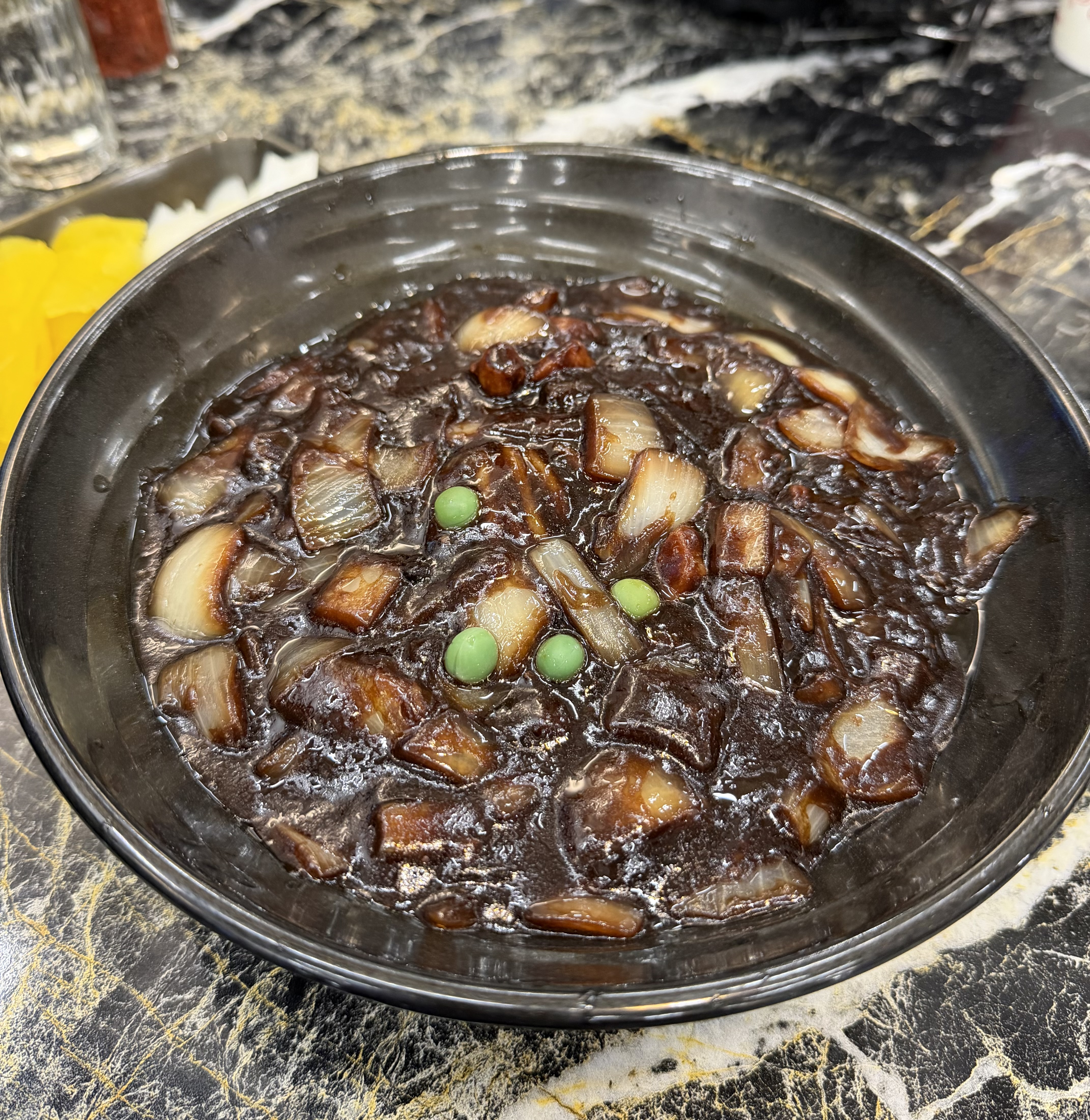
Jajangmyeon (jjajangmyeon, 짜장면) is one of the most loved dishes in Korea. Thick, hand-pulled wheat noodles are drenched in a savoury-sweet black bean paste sauce called chunjang (춘장), loaded with diced pork, onions, zucchini, and potatoes.
Originally adapted from Chinese zhájiàngmiàn by early immigrants in Incheon's Chinatown, jajangmyeon has become a uniquely Korean comfort food — ordered by the millions every day through delivery apps and eaten to celebrate everything from moving day to heartbreak.
What Makes It Special
The magic is in the sauce. Chunjang — a fermented black soybean paste — is stir-fried in oil until fragrant, then simmered with diced pork belly, onions, cabbage, zucchini, and potato.
The result is a glossy, near-black sauce that's savoury, slightly sweet, and deeply umami. Unlike its Chinese ancestor, the Korean version is thicker, sweeter, and always served over fresh noodles rather than dry ones.
Types of Jajangmyeon
- Jajangmyeon (짜장면) — the classic. Hand-pulled noodles in black bean sauce with diced pork and vegetables. This is what 90% of people order.
- Ganjjajang (간짜장) — the sauce is served on the side, unstretched with starch. Thicker, more intensely flavoured, and considered the connoisseur's choice.
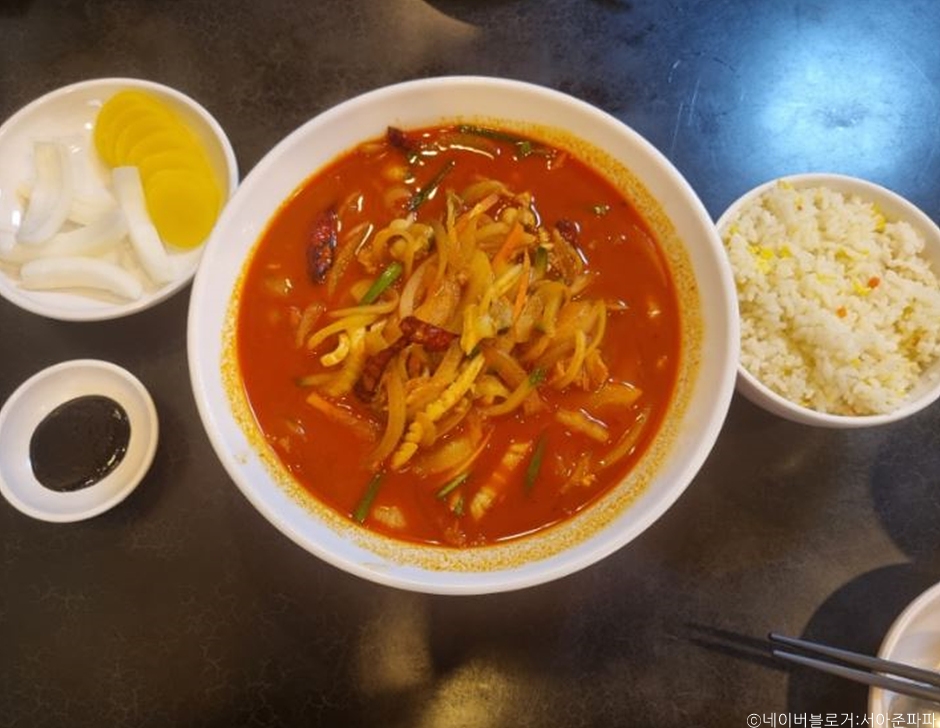
- Jjamppong (짬뽕) — not jajangmyeon, but its eternal rival. A fiery red seafood noodle soup. Koreans agonise over the "jajangmyeon vs jjamppong" choice at every Chinese restaurant. The solution? Order both and share.
- Jjajangtteokbokki (짜장떡볶이) — chewy rice cakes in black bean sauce instead of the usual spicy red. A popular street food twist.
- Jaengban Jajang (쟁반짜장) — a shareable platter version with noodles spread on a large tray and topped with extra seafood and vegetables. Perfect for groups.
How to Eat
Jajangmyeon arrives in a wide bowl with the dark sauce pooled on top of pale noodles. Here's the routine:
- Mix thoroughly — grab your chopsticks and toss the noodles until every strand is coated in black sauce. Don't be shy. Splatter marks on your shirt are a badge of honour.
- Bite the danmuji — yellow pickled radish (danmuji, 단무지) always comes on the side. Take a crunchy bite between noodle slurps to cut the richness.
- Dip raw onion in sauce — sliced raw onion with a small dish of chunjang dipping sauce is the classic side. The sharp bite of onion balances the sweet-savoury noodles perfectly.
- Slurp loudly — noodle slurping is not just accepted in Korea, it's expected. Quiet noodle eating is the real faux pas.
Black Day: The Singles' Holiday
Korea has a unique relationship with jajangmyeon that goes beyond food. Every year on April 14th — Black Day — single people who didn't receive gifts on Valentine's Day (Feb 14) or White Day (Mar 14) gather to eat jajangmyeon together.
The "black" in Black Day refers to the colour of the sauce. It started as a joke among university students in the 1990s but is now a genuine cultural event, with restaurants offering Black Day specials and social media flooding with solo jajangmyeon photos.
Jajangmyeon is also the go-to moving day meal (isa-nal, 이사날). When Koreans move to a new home, the first meal ordered is almost always jajangmyeon delivery — it's fast, cheap, feeds a crowd, and requires zero kitchen setup. You'll see this in countless K-dramas.
Where to Find the Best
- Any Chinese restaurant (중국집) — every neighbourhood in Korea has at least one junggukjip (Chinese restaurant). Jajangmyeon is always item #1 on the menu. These aren't fancy — plastic tables, laminated menus, and lightning-fast delivery.
- Delivery apps — jajangmyeon is consistently the #1 most-delivered food in Korea. Order through Baemin (배민) or Coupang Eats and it arrives in 20–30 minutes, often in the iconic metal geumsok bowls that get collected later.
- Seoul hot spots — Myeongdong and Hongdae have tourist-friendly Chinese restaurants. For a more local experience, try the Chinese restaurants near university areas like Sinchon or Konkuk.
Price Range
Jajangmyeon is one of Korea's most affordable meals. A regular bowl costs ₩6,000–8,000 at most neighbourhood Chinese restaurants.
Ganjjajang (the premium unstretched version) runs ₩8,000–10,000. Delivery adds ₩1,000–2,000 for the service fee but often has no minimum order.
A full Chinese restaurant meal with jajangmyeon, tangsuyuk (sweet and sour pork), and jjamppong to share will cost about ₩25,000–35,000 for two people.
Tips for First-Timers
- Order tangsuyuk on the side — sweet and sour pork (tangsuyuk, 탕수육) is the #1 companion dish. Crispy battered pork with a sticky fruit sauce. Order a small (소) for 1–2 people or a large (대) for a group.
- Ask for gopbaegi — say "gopbaegi juseyo" (곱배기 주세요) to get a double-sized portion for just ₩1,000–2,000 extra. Essential if you're hungry.
- Expect stains — the black sauce stains clothes. Restaurants often provide plastic aprons. Wear something dark or accept your fate.
- Delivery bowls get collected — if you order delivery, leave the metal bowls outside your door when done. The restaurant picks them up later. Don't throw them away.
- Can't decide? Get jjamjjamyeon — some restaurants offer jjamjjamyeon (짬짜면), a half-and-half bowl with jajangmyeon on one side and jjamppong on the other. Problem solved.
A History Worth Knowing
Korea's jajangmyeon story begins not with a chef's invention but with immigration and adaptation. Chinese workers who came to Incheon in the late 19th century to help build the port brought their noodle traditions with them. The first generation of Korean-Chinese restaurants — called hwa-gyo (화교) restaurants — clustered around Incheon's Chinatown and served dishes recognisable to the immigrant community.
The dish that would become jajangmyeon crystallised around 1905 at Gonghwachun (공화춘), a restaurant on the hill above Incheon's Chinatown that is now preserved as the Jajangmyeon Museum (짜장면박물관). The restaurant adapted zhájiàngmiàn — a northern Chinese noodle dish with fermented soybean paste — for Korean tastes: sweeter sauce, softer noodles, more vegetables, and eventually pork belly replacing the leaner Chinese cuts.
The dish remained a regional specialty until the 1960s, when the Korean government's flour promotion policy (bungshik jangryeo undong, 분식장려운동) actively encouraged wheat-based foods over rice to address grain shortages. Chinese restaurants became vectors for this policy — jajangmyeon was cheap, filling, and could be made fast. By the 1970s, it had spread from Incheon to every city neighbourhood in Korea.
A key inflection point came in 1980, when Korea nationalised the price of jajangmyeon as a "national food" (gungmin eumsik), capping it to keep it affordable for all income levels. This price control lasted until 2000, which is partly why the dish retains its powerful association with democratic access — the idea that anyone, regardless of financial situation, can sit down to a bowl of jajangmyeon.
Black Day and the Korean Love Calendar
To fully understand Black Day, you need the broader context: Korea has a "14th of every month" romance culture that has no real equivalent anywhere else in the world. The calendar runs like this:
- January 14 — Diary Day: Couples exchange diaries or planners as a symbol of shared plans for the year ahead.
- February 14 — Valentine's Day: Women give chocolate to men — the reverse of the Western tradition. Homemade chocolate carries extra weight.
- March 14 — White Day: Men return the gesture with candy, gifts, and typically something more expensive than the original Valentine's offering.
- April 14 — Black Day: Single people who received nothing on the two preceding days eat jajangmyeon together, often dressed in black, mourning their romantic situation — almost always with considerable self-aware irony.
- May 14 — Rose Day / Yellow Day: Couples exchange roses. In some regional variations, singles eat curry (yellow) instead of jajangmyeon.
Black Day is simultaneously genuine cultural participation and a self-aware joke. Seoul restaurants near universities — Sinchon, Hongdae, Konkuk, Anam — fill on April 14 evenings with groups of single friends who have dressed up, ordered matching bowls, and are posting extensively to Instagram and TikTok. The #blackday hashtag on Korean social media typically generates hundreds of thousands of posts on the day, ranging from genuinely melancholy to deliberately absurd.
The mood is rarely sad — it is closer to a collective ironic celebration. Many restaurants offer Black Day specials: jet-black noodle variations using squid ink, all-black plating, or set menus with black sesame dessert. Some venues hand out black roses to solo diners. The event has been covered by international media and has become a genuine cultural draw for visitors who time their Korea trip around mid-April.
Tip for visitors: If you are in Korea on April 14, go to any Chinese restaurant (junggukjip) near a university area. You do not need to be single to participate — the event is inclusive and self-deprecating enough to welcome everyone. Order jajangmyeon, wear something dark, and join the tradition. The communal atmosphere in the restaurant will be immediately apparent.
Ordering Delivery as a Foreigner
Jajangmyeon is consistently the single most-delivered food in Korea, which means the delivery infrastructure around it is extraordinarily well-developed. Even without Korean language ability, ordering is manageable with a small amount of preparation.
Step-by-step for first-timers:
- Step 1: Download Baemin (배달의민족) — the dominant delivery app in Korea. Coupang Eats is a strong alternative. Both are Korean-language apps, but the ordering flow is standardised enough to navigate visually.
- Step 2: Set your delivery address. If you are staying at a hotel, type the hotel name in Korean script (use Google Translate to convert the name first). Most major hotels are pre-loaded in the app's address database.
- Step 3: Search for 짜장면 (jajangmyeon). The results will surface nearby Chinese restaurants ranked by rating and distance. Tap the star ratings to see photo menus — the visual menus make identification straightforward even without reading Korean.
- Step 4: Identify your dishes. Jajangmyeon (짜장면) is ₩7,000–9,000. Jjamppong (짬뽕) is ₩8,000–10,000. Tangsuyuk (탕수육) small is ₩13,000–18,000.
- Step 5: Payment. Korean credit and debit cards work reliably. Many international Visa and Mastercard cards now process correctly as well. If payment fails, Kakao Pay is an alternative, or ask your hotel reception to place the order on your behalf — they handle this regularly for foreign guests.
- Step 6: Wait 20 to 35 minutes. Track on the app map.
The metal bowl system: Jajangmyeon arrives in a reusable metal bowl (geumsok geuseuleu, 금속그릇). When you finish eating, leave the bowl outside your door or at the building entrance. The delivery driver returns later the same day, or the following morning, to collect all bowls from the building. Do not throw the bowls away and do not take them home — restaurants track their bowl inventory carefully and the system depends on the return cycle functioning correctly.
Convenience store alternative: GS25 and CU convenience stores stock cup jajangmyeon (jajangmyeon ramyeon, 짜장라면) for ₩1,200–2,000. Add hot water from the in-store dispenser, wait three minutes. It is not the real thing, but it is a legitimate late-night option when restaurants have closed and the delivery apps have shifted to a limited menu. Several cup versions — particularly Paldo Jjajangmen — have become cult favourites in their own right.
How to Read a Korean Chinese Restaurant Menu
Korean Chinese restaurants (junggukjip, 중국집) follow a near-universal menu structure across the entire country. Understanding this structure removes all ordering uncertainty and lets you navigate any laminated menu in any neighbourhood.
The three-section structure:
- Section 1 — 면류 (myeon-ryu), Noodle Dishes: Jajangmyeon (짜장면) is almost always item 1. Jjamppong (짬뽕) is item 2. Ganjjajang (간짜장) is typically item 3. Jaengban Jajang (쟁반짜장) appears later in this section as a group-order item.
- Section 2 — 밥류 (bap-ryu), Rice Dishes: Jajang fried rice (jajang bokkeumbap, 짜장볶음밥) lives here, along with egg fried rice and occasionally kimchi fried rice variants.
- Section 3 — 요리 (yori), Shared Dishes: This is the shareable food section. Tangsuyuk (탕수육, sweet and sour pork), mapa tofu (마파두부), and larger hotpot dishes appear here. Sizes are marked 소 (small), 중 (medium), 대 (large).
How many dishes to order: Korean Chinese restaurants expect one noodle dish per person, plus shared yori dishes at the table. For two people, the standard combination is two bowls of noodles plus one small tangsuyuk (소 탕수육). For four people, two bowls each plus a medium or large tangsuyuk is typical.
Useful phrases for ordering:
The tangsuyuk dipping debate: A famous Korean food argument — buje vs buccheok (부먹 vs 찍먹) — divides the country on whether to pour (buje) the sweet and sour sauce over the tangsuyuk all at once, or to dip (buccheok) each piece individually. Koreans hold strong opinions. The technical case for dipping is that the batter stays crispier. The practical case for pouring is speed. Both are socially acceptable. Raising the debate at the table is guaranteed to generate an immediate and spirited reaction from Korean dining companions.
2026 Price Reality Check
Jajangmyeon prices have increased noticeably since 2022 due to ingredient cost inflation and higher labour costs, though the dish remains one of Korea's best value meals. The original price ranges cited in many older travel guides are no longer accurate. The table below reflects 2025–2026 pricing across different venue types.
| Item | Neighbourhood restaurant | Tourist area (Myeongdong / Hongdae) |
|---|---|---|
| Jajangmyeon (regular) | ₩7,000–9,000 | ₩9,000–12,000 |
| Ganjjajang | ₩9,000–12,000 | ₩12,000–15,000 |
| Jjamppong | ₩8,000–10,000 | ₩10,000–13,000 |
| Tangsuyuk (small / 소) | ₩13,000–18,000 | ₩18,000–25,000 |
| Jaengban Jajang (large tray) | ₩20,000–30,000 | ₩25,000–35,000 |
A full meal for two — two noodle bowls plus one small tangsuyuk — now runs approximately ₩30,000–45,000 depending on neighbourhood, compared to the ₩25,000–35,000 range common before 2022.
Delivery adds a platform fee of ₩2,000–4,000 on top of the food price. Most Chinese restaurants on delivery apps set a minimum order of ₩12,000–15,000, which one bowl of noodles plus a shared dish easily clears. If you are ordering solo, jajangmyeon alone typically meets the minimum at most restaurants.
Jajangmyeon in K-Drama and K-Pop Culture
For K-culture fans visiting Korea, jajangmyeon carries significant cultural weight that goes well beyond its role as a meal. It appears repeatedly as a shorthand symbol in Korean media — for comfort, domesticity, solidarity, and fresh starts.
The moving-day ritual on screen: In virtually every K-drama scene involving a house move, the characters order jajangmyeon immediately upon arrival at the new home — before unpacking, before furniture is arranged, sometimes before the boxes are even brought inside. Notable examples appear in My Mister (나의 아저씨), Reply 1988 (응답하라 1988), and It's Okay to Not Be Okay (사이코지만 괜찮아). The moving-day jajangmyeon scene functions as K-drama shorthand for domesticity, shared effort, and the human need to pause and eat even in chaos.
Black Day in drama plots: Several romantic comedies use Black Day as a narrative device — characters meeting unexpectedly, breaking up, or having a turning-point conversation over a solo bowl of jajangmyeon. The dish appears in emotionally significant scenes in My Love from the Star (별에서 온 그대) and Goblin (도깨비), among others. For fans who have watched these scenes, ordering jajangmyeon in Korea carries an additional layer of cultural recognition.
Idol culture connections: G-Dragon of BIGBANG has mentioned jajangmyeon as a personal comfort food in multiple interviews — a detail that circulates repeatedly in fan communities. Idol survival programmes including Produce 101 and Idol School used jajangmyeon delivery as a contestant reward, a choice that resonates with Korean audiences precisely because it signals ordinary comfort and normalcy amid the artificial pressure of the competition format.
For visitors: Ordering jajangmyeon at a neighbourhood junggukjip is one of the most direct ways to participate in a food culture that appears across Korean media. The physical experience — laminated menu, plastic table, fast no-ceremony service, danmuji on the side, black sauce arriving in a wide metal bowl — is identical to what you have seen on screen. Nothing is staged or performed for tourists. This is simply what eating jajangmyeon in Korea looks and feels like, and it has looked this way for decades.