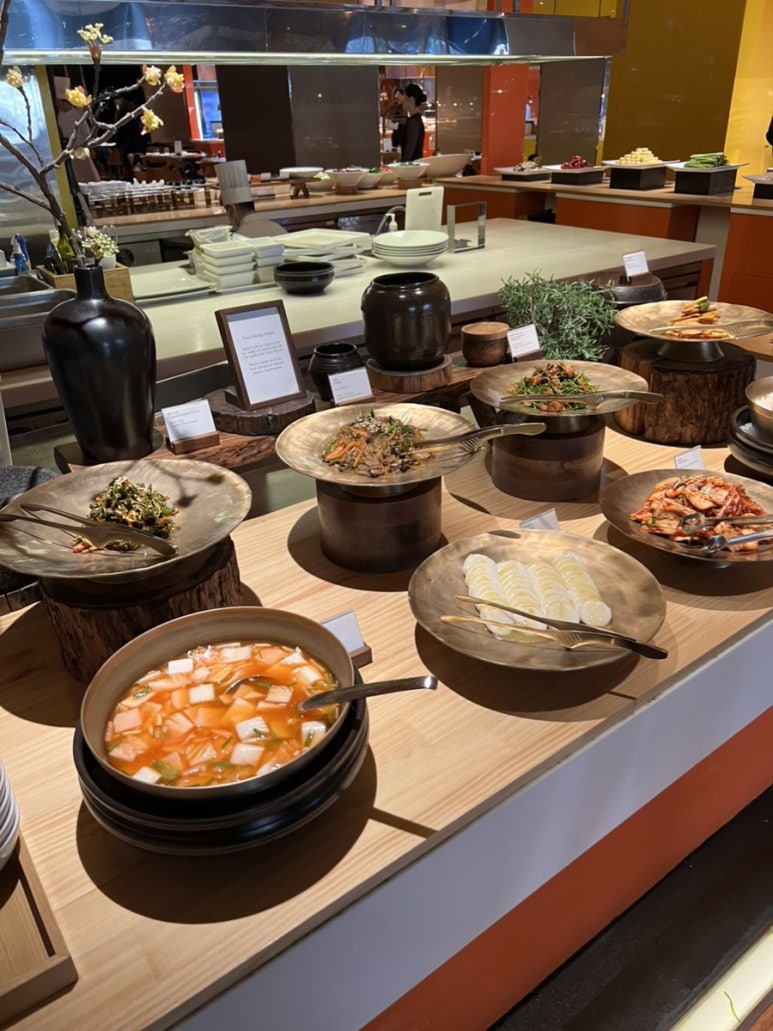
Korea takes buffets seriously — from no-frills hansik lunch spreads where office workers clean their plates in 15 minutes, to multi-course hotel feasts that cost more than a flight ticket. The Korean word for buffet is bwipe (뷔페), borrowed from French, but locals have completely reinvented the format into something distinctly their own: unlimited self-service dining at a fixed price, spanning five very different worlds depending on your budget and mood.
The 5 Types of Korean Buffets
1. Family Restaurant Buffets (패밀리레스토랑 뷔페)
The most recognizable buffet format for foreigners, Ashley Queens (aesheul-li queens, 애슐리퀸즈) and VIPS dominate this category. Both chains nearly collapsed in the early 2020s before surging back — Ashley Queens expanded from 59 stores in 2022 to 115 by 2024, riding the wave of value-hungry diners hit by food price inflation.
- Ashley Queens (애슐리퀸즈) — Over 200 dishes spanning Korean, Western, sushi, BBQ, and desserts. All-you-can-drink beer and wine available at dinner. Price: ₩19,900 (weekday lunch) / ₩27,900 (weekend). Best for families and groups.
- VIPS — CJ Foodville's upscale take. Famous for a generous salad bar with DIY taco and salad corners. Focuses more on Western-style dishes and quality ingredients. Price: ₩30,000–40,000 range. Best for date nights and slow, relaxed dining.
Both are found inside major malls and department stores — look for them in Lotte Mart, CGV complexes, and E-Mart. Ashley Queens is the better budget pick; VIPS leans more premium.
2. Korean Food Buffets (한식뷔페)
The hansik buffet (한식뷔페) was once Korea's biggest casual dining trend — dozens of brands including Jayeonbyeolgok (jayeon-byeol-gok, 자연별곡), Gyejeol Bapsang (계절밥상), and Olban (올반) competed for mall space. Most have closed or pivoted to meal kits, leaving Jayeonbyeolgok as the last major standalone chain.
- Jayeonbyeolgok (자연별곡) — ELand's flagship hansik buffet. Seasonal Korean home-style dishes: braised meats, jeon (Korean pancakes), rice dishes, soups, and traditional desserts. Beautiful hanok-style interiors. Price: ₩19,900 (weekday lunch) / ₩29,900 (weekend). Location: select Lotte Malls.
- Budget hansik buffets — Smaller local restaurants near office districts serve a simplified version for ₩9,000–15,000: unlimited rice, soup, and 10–15 banchan. No frills, very fast, exactly what a Korean lunch break looks like.
Hansik buffets are the most culturally immersive option — you'll be eating what Korean grandmothers cooked at home: doenjang jjigae, japchae, galbi-jjim, kimchi varieties, and seasonal jeon. Arrive before noon on weekdays to avoid long queues.
3. Shabu-Shabu Buffets (샤브샤브 뷔페)
Shabu-shabu (샤브샤브) — thinly sliced meat and vegetables simmered in a light broth at the table — has become one of the most popular buffet formats in Korea. Unlike Japanese shabu-shabu which is often à la carte, Korean chains offer fully unlimited service: you pick up what you want from the buffet bar and cook it yourself.
- Shabu All Day (샤브올데이) — 2024 Korean Quality Satisfaction Award winner. Hotel-like interiors with 60+ menu items including beef, pork, seafood, vegetables, rice paper rolls (wolnam-ssam, 월남쌈), and desserts. Unlimited draft beer at dinner. Price: ₩25,000–35,000. Growing chain now in major cities.
- Shabu & Salad Bar (샤브 & 샐러드바) — More casual format combining a Western-style salad bar with shabu-shabu. Popular in Seoul. Price: ₩14,800–19,800.
- Barmi Shabu (바르미 샤브샤브) — Budget-friendly chain, ₩12,000–16,000 for unlimited meat, vegetables, and noodles. Less premium but solid value for solo diners.
The ritual: dip thin slices of meat into the simmering broth for 10–15 seconds, add vegetables and tofu, then finish with kal-guksu (칼국수, hand-cut noodles) or rice cooked in the leftover broth. This final step, called meok-guk (먹국), is considered the best part of the whole meal.
4. Office Worker Lunch Buffets (직장인 점심 뷔페)
Near every major office cluster in Seoul — Yeouido, Gangnam, Euljiro, Pangyo — you'll find small Korean buffet restaurants that open only for lunch, serving the 12:00–1:30 PM rush at breakneck speed. These are not tourist spots; they are function over form, but they offer one of the most authentic glimpses into everyday Korean eating.
- BabPlus (밥플러스) — A popular self-serve chain. Pay at the counter, grab a tray, fill up with rice, soup, and rotating banchan. Clean, fast, filling. Price: ₩8,000–11,000.
- Local neighbourhood buffets — Unmarked or simply signed han-sik-bwi-pe (한식뷔페), these independent restaurants near business districts serve ₩9,000–13,000 lunch sets. Menu changes daily. Lines can stretch outside during peak hours.
Eating etiquette: move quickly, don't linger over a full plate, and expect to be done in under 20 minutes. A small glass of sikhye (식혜, sweet rice punch) is often available as a post-meal digestif. Break time usually starts at 2:30 PM — arrive before 1:00 PM or after 1:30 PM to avoid the worst of the rush.
5. Seasonal Buffets (시즌 뷔페)
Korea has perfected the art of the seasonal limited-run buffet, and nothing captures this better than the annual ttalgi bwipe (딸기 뷔페, strawberry buffet). Running from December to early April when Korean strawberries are at their peak, hotel dessert buffets transform their pastry sections into strawberry showcases: tarts, cakes, fresh fruit stations, fondue, soft-serve, and parfaits, all centred on the plump, intensely sweet Seolhyang (설향) and Kingsberry (킹스베리) varieties.
- JW Marriott Dongdaemun Square — Salon de Strawberry — Hybrid afternoon tea and buffet format. Around 20 dessert varieties using premium strawberry selections. Price: ₩78,000 (weekday) / ₩88,000 (weekend).
- Seoul Dragon City — THE 26 Strawberry Studio — One of the most photographed venues in Seoul. Sky-high views from the 26th floor. Price: ₩110,000 per adult (2025 season).
- Lotte Hotel Seoul — Starry Starry Strawberry — Full dessert spread plus light savouries. Runs through late April. Price: approx. ₩70,500 per person.
- Ashley Queens — Budget Strawberry Season — Some branches add strawberry dessert menus in spring at the standard buffet price of ₩19,900–27,900. Far less theatrical but a fraction of the cost.
Beyond strawberries, watch for peach (boksunga, 복숭아) summer buffets in July–August and autumn harvest-themed spreads at hotels from October to November. These sell out weeks in advance — book the moment the season is announced.
6. Hotel Buffets (호텔 뷔페)
Seoul's Big 3 hotel buffets — La Seine (라세느) at Lotte Hotel World, The Parkview (더 파크뷰) at Hotel Shilla, and Aria (아리아) at Chosun Hotel — are considered the gold standard. Expect free-flowing seafood: live oysters, king crab, sashimi, and grilled premium meats alongside a full international spread. Dinner prices now routinely exceed ₩200,000 per person.
- Hotel Shilla — The Parkview (더 파크뷰) — Consistently ranked Korea's best hotel buffet. Exceptional sashimi, dim sum, and seafood selection. Full dinner: ~₩200,000.
- JW Marriott Seoul — Flavors — ₩142,000 weekday lunch / ₩157,000 weekday dinner and weekends (2025 pricing). Outstanding quality-to-price ratio for a 5-star buffet.
- AC Kitchen, AC Hotel Seoul Gangnam — ₩95,000 weekday lunch / ₩150,000 weekend. Lobster available unlimited during certain promotional periods. Strong value among luxury options.
Reservations are essential, often 2–4 weeks in advance for weekends. Lunch service typically runs 11:30 AM–2:30 PM, dinner 6:00–9:30 PM.
Price Guide at a Glance
- ₩8,000–15,000 — Office worker lunch buffets, budget hansik chains (BabPlus, local restaurants near business districts)
- ₩19,900–29,900 — Family restaurant buffets (Ashley Queens, VIPS salad bar), Jayeonbyeolgok hansik buffet, mid-range shabu-shabu
- ₩30,000–50,000 — Premium shabu-shabu (Shabu All Day dinner), VIPS full menu
- ₩70,000–120,000 — Hotel lunch buffets, seasonal dessert buffets (strawberry, peach)
- ₩140,000–200,000+ — Hotel dinner buffets (Big 3), luxury seasonal events
Tips for First-Timers
- Go at opening time. Popular spots — especially Ashley Queens and hotel buffets on weekends — fill up fast. Arrive 10 minutes early.
- Start with the hot items. Korean buffets rotate dishes; the freshest items appear at opening. Don't fill your plate with salad first.
- Lunch is dramatically cheaper. The same restaurant can cost 30–40% less at lunch versus dinner. If budget matters, always go for the lunch sitting.
- Children get steep discounts. Most chains price children at half the adult rate; under-3s are often free. Ashley Queens is particularly family-friendly.
- Book seasonal buffets early. Strawberry season hotel buffets sell out 2–3 weeks ahead. Check the hotel's official website in November for early-bird booking.
- Bring cash or check payment options. Most chain buffets accept cards, but smaller office-district lunch spots may be cash-only.