Find It on the Map
Joseon's principal palace, founded in 1395, with grand throne halls, a royal guard-changing ceremony and free entry when you wear rented hanbok.
From Your Hotel Area
→ Gyeongbokgung Palace경복궁
The Palace That Defined a Dynasty — Built in 1395, Restored to Full Scale
Gyeongbokgung (경복궁) means "Palace Greatly Blessed by Heaven," a name chosen with deliberate ambition by the founders of the Joseon Dynasty in 1395. It was the first and greatest of Seoul's five royal palaces, the seat of government and the residence of the royal family for more than 200 years, a complex so large that its grounds could contain four versions of today's visit in different directions simultaneously. Standing at the main gate and looking north toward the mountains that frame the palace on three sides, you can understand exactly why King Taejo chose this site: it is positioned according to traditional Korean geomantic principles, with mountains behind and a river before, the physical landscape arranged as if designed to amplify the authority of whoever built here.
The palace was burned during the Japanese invasion of 1592, rebuilt, burned again, and eventually demolished almost entirely during the second Japanese colonial period in the early 20th century. What you see today is largely the result of a multi-decade restoration project that began in earnest in the 1990s. The main ceremonial buildings — Geunjeongjeon, Gyeonghoeru Pavilion, Hyangwonjeong Pond — are restored originals or careful reconstructions. The scale is still staggering. Walking the full grounds takes two hours at minimum; most visitors who rush through in 45 minutes leave with no real sense of the place.
Key Buildings and Spaces
Gwanghwamun Gate (광화문)
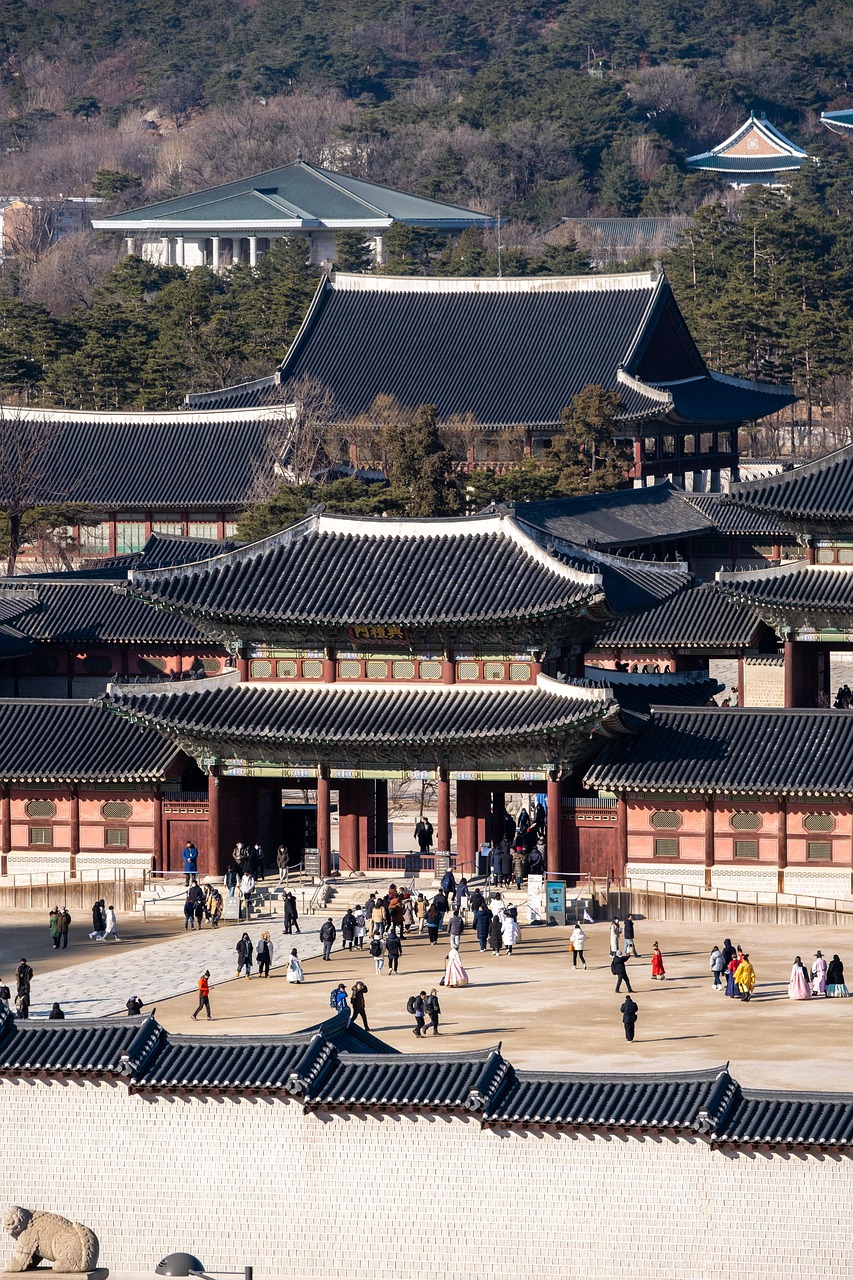
The main gate of Gyeongbokgung, facing south down Sejong-daero toward the Han River. It is one of Seoul's most recognizable landmarks and the starting point for most visits. The gate was rebuilt in 2010 after the colonial-period relocation; the current position and orientation restore the original alignment. Arrive early enough and you can photograph it against a blue sky without the crowds that accumulate by 10am.
Heungnyemun Gate and the Inner Court
Between Gwanghwamun and the main throne hall lies a second gate, Heungnyemun, and a wide stone-paved courtyard. This transitional space — outside the inner palace but inside the outer wall — was historically where officials gathered before royal audiences. The sense of scale begins here: the stones underfoot, the weight of the wall, the mountain visible above the roofline ahead.
Geunjeongjeon — The Throne Hall (근정전)
The main throne hall of Gyeongbokgung is the largest wooden structure in Korea. It sits on a double-tiered stone platform in the center of a vast stone courtyard. Kings held formal court here, received foreign envoys, and were enthroned. The interior, visible through the doors on ceremonial days or through the lattice windows, contains the royal throne backed by a painted screen depicting the sun, moon, and five mountain peaks — a symbolic backdrop that appears in countless Korean films and dramas. The entire courtyard, which accommodates 20,000 people in ceremonial formation, is genuinely humbling in its dimensions.
Gyeonghoeru Pavilion (경회루)
A two-story wooden pavilion built on stone pillars over a large artificial lake, used for royal banquets, rain prayers, and diplomatic receptions. Gyeonghoeru is considered one of the most beautiful structures in Korean architecture — the pavilion's reflection in still water, with Bugaksan mountain behind, is one of Seoul's most photographed compositions. The pavilion itself is only accessible on guided tours (book through the cultural heritage site); the view from the lakeside walkway is freely available and excellent.
Hyangwonjeong Pond and Pavilion (향원정)
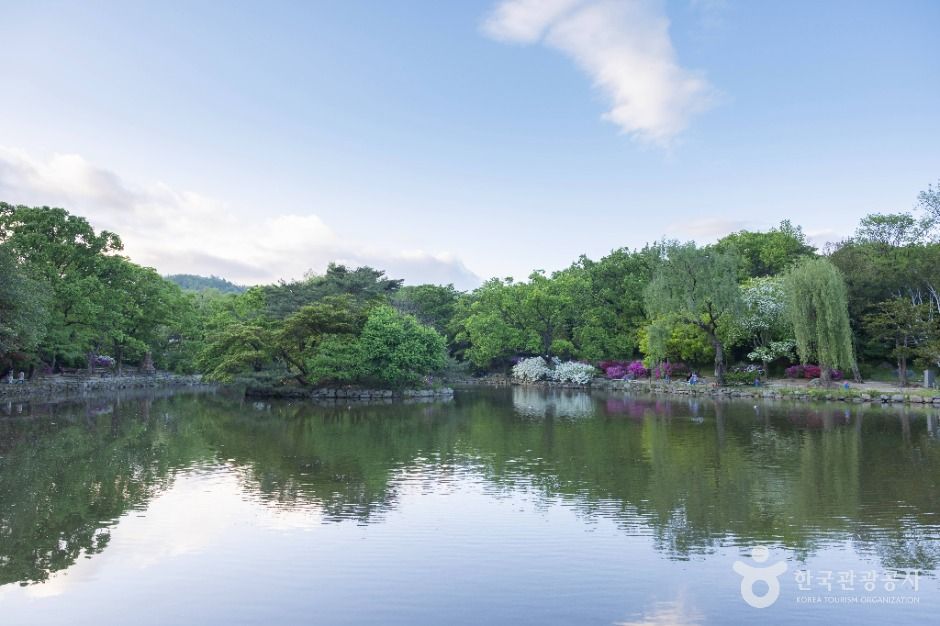
In the northern section of the palace grounds, a smaller hexagonal pavilion sits on an island in a lotus pond, connected to the bank by a wooden footbridge. The setting is more intimate than Gyeonghoeru — quieter, often less crowded, the scale human rather than imperial. This is where the royal family retreated for private time. The pond is particularly beautiful in early morning with mist on the water, and in October when the surrounding trees turn.
National Folk Museum (국립민속박물관)
Inside the palace grounds and included with the general admission ticket, the National Folk Museum documents daily life in Korea from prehistoric times through the 20th century. The outdoor section — which includes reconstructed village buildings, traditional tools, and seasonal displays — is excellent for visitors who want context for what life looked like outside the palace walls. Budget 45–60 minutes for a meaningful visit. Signage is available in English, Japanese, and Chinese throughout.
National Palace Museum of Korea (국립고궁박물관)
Adjacent to Gyeongbokgung's eastern entrance and free to enter separately from palace admission. Houses the largest collection of royal Joseon artifacts in existence: thrones, ceremonial robes, court paintings, astronomical instruments, and royal documents. The 2,000+ objects on display represent the material culture of 500 years of dynastic rule. If the palace itself is the architecture of power, this museum is its contents. Plan 60–90 minutes minimum.
Changing of the Royal Guard Ceremony
The Royal Guard Changing Ceremony (수문장 교대의식) takes place at Gwanghwamun Gate daily at 10am and 2pm, except Tuesdays. It lasts approximately 20 minutes and is entirely free to watch. The ceremony is a reconstruction of the Joseon-era gate guard rotation: elaborately costumed guards march in formation to traditional music, perform the handover ritual, and take positions at the gate. It is photographically spectacular — the colour of the uniforms against the stone gate is remarkable — and a genuine historical practice rather than a theatrical recreation invented for tourism.
Arrive 15 minutes early for a front-row position. The ceremony is canceled in heavy rain. Tuesday is the weekly rest day for the guard unit.
Hanbok for Free Entry
Visitors wearing hanbok (한복) — traditional Korean clothing — enter Gyeongbokgung for free. This policy applies to all visitors, Korean and foreign alike, and has been in place since 2013 as part of a broader government effort to revive interest in traditional dress. Hanbok rental shops line the streets immediately outside the main gate, particularly on Hyoja-ro and the lanes off Gyeongbokgung-ro. Rentals start from ₩15,000–20,000 for two hours and include dressing assistance. The same hanbok admission policy applies at Changdeokgung, Deoksugung, and other royal palaces in Seoul, so a single rental can cover multiple sites in one day.
Getting There
Take Line 3 to Gyeongbokgung Station and use Exit 5. The exit leads directly to Gwanghwamun Gate; the palace entrance is a 3-minute walk. Alternatively, Anguk Station (Line 3, Exit 1) places you at the east entrance in 5 minutes and is slightly less crowded as an approach. From central Seoul (Myeongdong area), take Line 4 to Chungmuro and transfer to Line 3 for two stops north.
Hours and Admission
- Hours: 9am–6pm (March–October); 9am–5pm (November–February). Extended to 6:30pm on weekends in summer.
- Closed: Every Tuesday. If Tuesday falls on a public holiday, the palace is open and closes the following day instead.
- Admission: ₩3,000 for adults (19+); ₩1,500 for teens (7–18); free under 7 and over 65.
- Free entry days: The last Wednesday of each month (Culture Day). Free for all visitors, no ticket required — and significantly more crowded than usual.
- Hanbok free entry: Applies every day during opening hours.
Best Times to Visit
- Early morning (9–10am): The palace opens at 9am. The first hour is the calmest — tour groups typically arrive from 10am. Morning light from the east is flattering on the south-facing throne hall.
- Spring (late March–early May): Cherry blossoms inside the palace grounds and the Gyeonghoeru lakeside. One of Seoul's most beautiful seasonal combinations.
- Autumn (mid-October–mid-November): Ginkgo trees along the main avenue and maple color on the hillside behind the palace. The combination of yellow leaves and grey tile rooflines is exceptional.
- Avoid: Weekend afternoons from May to October, when domestic and international tourism peaks. Chuseok and Lunar New Year holidays bring large family crowds but also add ceremonial atmosphere.
Nearby — Extend Your Visit
- Bukchon Hanok Village: 15-minute walk northeast. A natural pairing — palace in the morning, hanok village in the afternoon before the crowds thicken.
- Gwanghwamun Square (광화문광장): Directly south of the main gate. The large public square with the Admiral Yi Sun-sin and King Sejong statues. A natural bookend to the palace visit.
- Cheongwadae (청와대): The former presidential Blue House, immediately north of Gyeongbokgung, opened to public visits in 2022. Free timed-entry tickets required; book through the official site. Allows you to walk the grounds of the presidential residence and see Bugaksan mountain up close.
- Insadong (인사동): 10-minute walk southeast. Traditional crafts, tea houses, and galleries. Good for an afternoon of slower-paced culture after the palace.
Tips for First-Time Visitors
- Three hours is the minimum for a real visit: Throne hall, pavilion, Folk Museum, guard ceremony — these do not compress into 45 minutes without feeling rushed. Plan three hours; allow for more.
- The audio guide is worth it: Available at the main ticket office in English, Japanese, Chinese, and French. ₩3,000 for the handset. The context it provides for each building dramatically improves the experience.
- Time the guard ceremony: If you want to see it at 10am, arrive at 9am, walk the grounds first, and position at Gwanghwamun by 9:45am. The 2pm performance is less crowded on weekdays.
- Wear comfortable shoes: The palace grounds are large, stone-paved, and uneven in places. Two to three kilometers of walking on the main route.
- The Folk Museum closes at 6pm: Same as the palace in summer, but leaves less buffer in winter when the palace closes at 5pm. Prioritize it early in your visit.