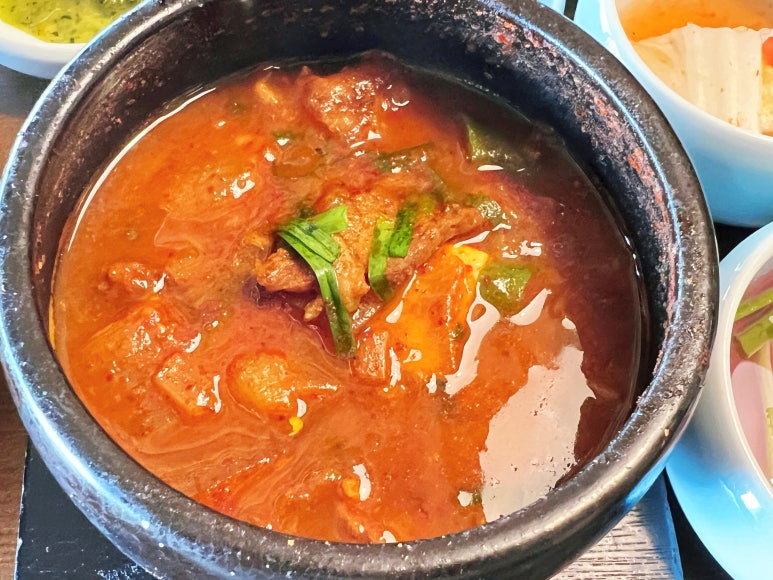
Korean food has three vessels for broth-based dishes — guk (국), tang (탕), and jjigae (찌개) — and the differences matter. Guk is a light soup, served in individual bowls, eaten alongside rice. Tang is a hearty, long-cooked broth, often featuring whole cuts of meat or bone. Jjigae (jji-gae, 찌개) sits between the two: a thick, intensely flavoured stew cooked in a small earthenware pot called a ttukbaegi (뚝배기) and placed directly on the table, still bubbling, to be eaten communally from the pot. If you have watched a Korean drama set in any domestic kitchen — a family gathered at a low table, a mother ladling something red and steaming into bowls, children eating rice alongside — you have seen jjigae. It is the centre of Korean home cooking in a way that has no Western equivalent. This guide covers the four jjigae every visitor to Seoul should know.
Kimchi Jjigae — The One Every K-Drama Fan Knows (김치찌개)
Kimchi jjigae (gim-chi jji-gae, 김치찌개) is the most recognised Korean stew internationally, driven by its constant presence in K-dramas as the definitive symbol of home cooking and maternal care. The dish is built on aged kimchi — the older and more fermented, the better — simmered with pork belly or pork shoulder, tofu, and a small amount of gochugaru (red chilli flakes) in a bright red broth. The fat from the pork renders into the broth, giving it a richness that fresh kimchi cannot produce. A proper kimchi jjigae uses kimchi that has been fermenting for at least three to four weeks; the sourness is what makes it work.
In K-dramas, kimchi jjigae is almost always the dish a character cooks when someone they love is sick, stressed, or returning home after a long absence. The association with comfort and care is so strong that the dish has emotional weight beyond its flavour. Ordering it at a Seoul restaurant means eating something Koreans genuinely associate with being looked after.
Standard pairings: plain steamed rice (gong-gi-bap, 공기밥), served on the side and spooned in according to preference. Do not pour the entire pot into your rice bowl — take small amounts of stew and rice together in each bite. Eating from the communal pot with a spoon is the norm; using chopsticks in the jjigae pot is considered slightly awkward.
Doenjang Jjigae — Fermentation's Deepest Expression (된장찌개)
Doenjang jjigae (dwen-jang jji-gae, 된장찌개) is built on doenjang (된장) — Korean fermented soybean paste, a cousin to Japanese miso but older, earthier, and more pungent. The paste is dissolved into an anchovy or kelp stock and simmered with tofu, zucchini (hobak, 호박), mushrooms, and sometimes clams or potato. The result is a murky, brown-grey stew with a flavour that is simultaneously salty, umami-rich, and slightly funky in the way that all great fermented foods are.
Doenjang jjigae does not look dramatic. It does not have the vivid red colour of kimchi jjigae or the theatrical bubbling of budae jjigae. What it has is depth — a flavour that has been developing over months or years in the fermentation of the paste. The quality of a restaurant's doenjang jjigae is often taken as a proxy for the quality of everything else they serve. If the doenjang is good, the kitchen is serious.
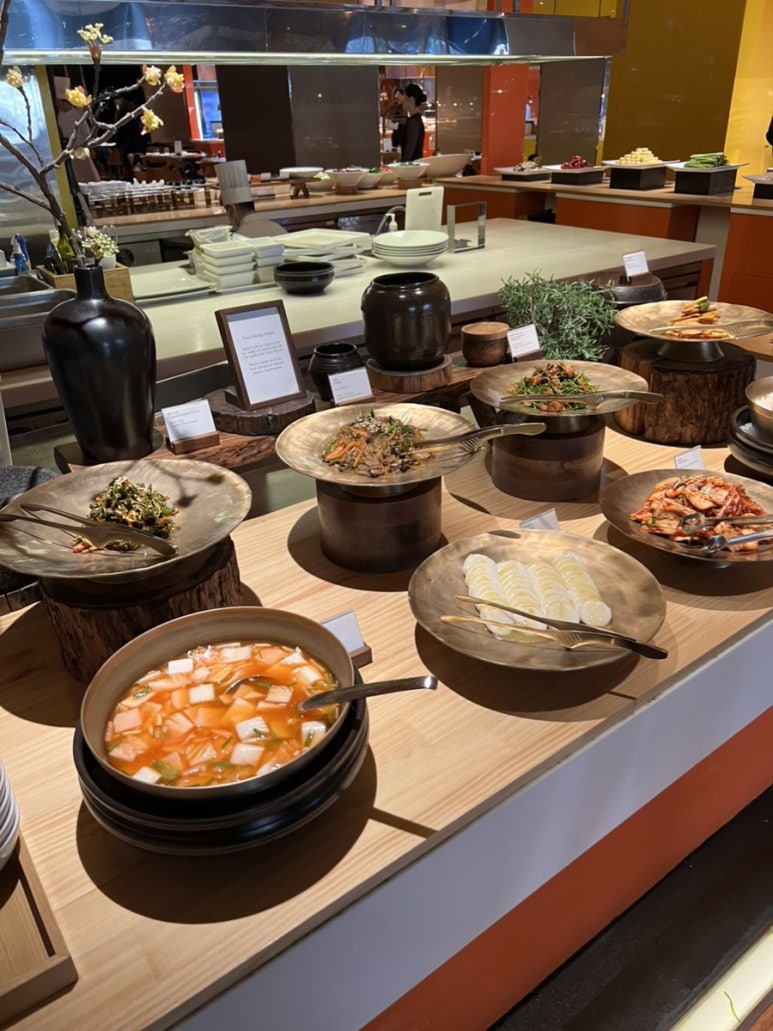
This is also the jjigae most often served as a banchan-style side stew alongside a main Korean set meal (han-jeong-sik, 한정식). Expect a small ttukbaegi of it at the corner of almost any traditional Korean meal you order.
Sundubu Jjigae — The Gentle Entry Point (순두부찌개)
Sundubu jjigae (sun-du-bu jji-gae, 순두부찌개) is the jjigae most accessible to first-time visitors. Sundubu (순두부) is uncurdled, silken soft tofu — not pressed into a block but served directly from the bag in loose, trembling curds. The broth is typically seafood-based (clams, shrimp, or a combination) with gochugaru for colour and heat, and a raw egg cracked in tableside just before serving. The egg poaches gently in the residual heat of the stew.
The texture combination is what makes sundubu jjigae distinctive: the silken tofu has almost no resistance, the broth is spicy and clean, and the egg yolk, if broken into the stew, creates a momentary richness that softens everything. It is a lighter stew than kimchi or doenjang jjigae, with a cleaner flavour profile, and for visitors who find the fermentation notes of the other two challenging, it is the most forgiving starting point.
Sundubu jjigae became internationally known partly through Korean-American restaurants in Los Angeles, where it became a gateway dish for non-Korean diners encountering Korean food for the first time. If you have eaten at a Korean restaurant in the US or UK, there is a reasonable chance sundubu was on the menu.
Budae Jjigae — The Stew With a History (부대찌개)
Budae jjigae (bu-dae jji-gae, 부대찌개) is the most historically complicated of the four. Budae (부대) means military base, and the dish originated in the years following the Korean War (1950–1953), when ingredients discarded or traded from US military base commissaries — SPAM, hot dogs, baked beans, processed cheese — were combined by Koreans with kimchi, gochugaru, and ramyeon noodles into a single bubbling pot. The city of Uijeongbu, north of Seoul, is credited with the earliest versions.
What began as wartime improvisation became a beloved dish in its own right. Today budae jjigae is a fixture on Korean menus, served in the same ttukbaegi format as other jjigae but with a noticeably different flavour profile — the SPAM and sausage give the broth a smoky, slightly processed quality that is entirely unlike traditional Korean ingredients, yet the kimchi and gochugaru anchor it firmly in Korean flavour logic. It is one of Korea's most successful accidental fusions.
Budae jjigae is typically ordered for two or more people and cooked at the table on a portable gas burner, ramyeon noodles added toward the end to absorb the remaining broth. The cheese slice placed on top and allowed to melt into the stew is mandatory at most restaurants.
How to Order Jjigae in Seoul
- Rice is always separate (gong-gi-bap, 공기밥). Jjigae is almost never served with rice included in the price. Order a bowl of steamed rice (usually ₩1,000–2,000) alongside your stew. Eating jjigae without rice is unusual.
- Spice adjustment is usually possible. Most restaurants can make jjigae less spicy on request. Say 덜 맵게 해 주세요 (deol maep-ge hae ju-se-yo) — "please make it less spicy." Doenjang jjigae is the least spicy of the four by default.
- The ttukbaegi stays hot. Jjigae arrives boiling and remains dangerously hot for several minutes. Do not grab the pot. Wait at least three to four minutes before eating from the edges of the bowl.
- Banchan is included. Every jjigae meal includes a set of side dishes at no extra charge. Kimchi, spinach namul, and bean sprouts are the most common. Eat them between spoonfuls of stew and rice.
- Budae jjigae requires a minimum of two portions. Because it is cooked at the table, solo dining is unusual. Most budae jjigae restaurants will confirm group size before seating.
Where to Find Jjigae in Seoul
Jjigae restaurants are ubiquitous in Seoul — almost every neighbourhood has several. The best concentrations for tourist-accessible dining are in Insadong (인사동) and Jongno (종로) for traditional kimchi and doenjang jjigae, Euljiro (을지로) for working-class lunch versions that are cheap and honest, and Itaewon (이태원) for sundubu jjigae restaurants that have adapted for international diners.
For budae jjigae specifically, the Uijeongbu area north of Seoul remains the origin-story destination, but excellent versions are available throughout the city. Look for restaurants advertising uijeongbu budae jjigae (의정부부대찌개) — this signals a version that follows the original recipe rather than a simplified commercial adaptation.
Use the Korea transportation guide to navigate between Insadong, Euljiro, and Itaewon, which are all accessible on the subway within 20 minutes of central Seoul.
Price Guide
- ₩7,000–10,000 — Kimchi jjigae or doenjang jjigae at a neighbourhood restaurant (lunch set includes rice and banchan)
- ₩8,000–12,000 — Sundubu jjigae at a specialist restaurant
- ₩10,000–15,000 per person — Budae jjigae (minimum two portions, cooked tableside)
- ₩12,000–18,000 — Premium versions with extra seafood, quality pork, or additional toppings
- Rice and banchan are standard inclusions at most jjigae restaurants
Tips for First-Timers
- Start with sundubu if you are spice-cautious. It is the mildest of the four by default and has the most forgiving flavour profile for first encounters with Korean stews.
- Do not eat from a jjigae pot that is still boiling. The ttukbaegi retains heat at an alarming level. Burned tongues are among the most common first-timer mistakes in Korean restaurants. Wait.
- Kimchi jjigae is better with aged kimchi. If you visit a restaurant and the kimchi jjigae tastes flat or watery, the kimchi was not fermented long enough. A properly aged kimchi jjigae has a pronounced sourness that should not be confused with spoilage — it is the point.
- Budae jjigae is a communal meal. Order it for a group, cook it together, and add the noodles at the end when you are nearly finished. The noodle step is not optional — it is the finale.
- Doenjang jjigae will smell strong. Fermented soybean paste has a pungent aroma that surprises first-timers. It is not an indication of spoilage. The smell fades as the flavour takes over.