Find It on the Map
Seoul's cultural heart with traditional tea houses, art galleries, and souvenir shops. Visit Ssamziegil for unique indie crafts and rooftop views.
From Your Hotel Area
→ Insadong인사동
Insadong: Seoul's Traditional Art and Culture District
Insadong (인사동) is Seoul's most celebrated traditional cultural street, running north from Tapgol Park to Anguk Station through the heart of Jongno-gu. For centuries this neighbourhood was home to antique dealers, calligraphy shops, and art galleries, and while the modern city has grown up around it, Insadong has held on to a character that is unlike anywhere else in Seoul. Today it draws both international visitors and Korean locals who come to browse galleries, drink traditional tea, eat street food, and pick up handmade crafts that cannot be found in the usual shopping districts.
On weekends the main street — Insadong-gil — goes car-free, giving the area a relaxed, pedestrian-friendly energy that makes it ideal for slow exploration. Whether you have two hours or a full afternoon, Insadong rewards unhurried visits.
What to See and Do in Insadong
Ssamziegil (쌈지길) — The Courtyard Mall
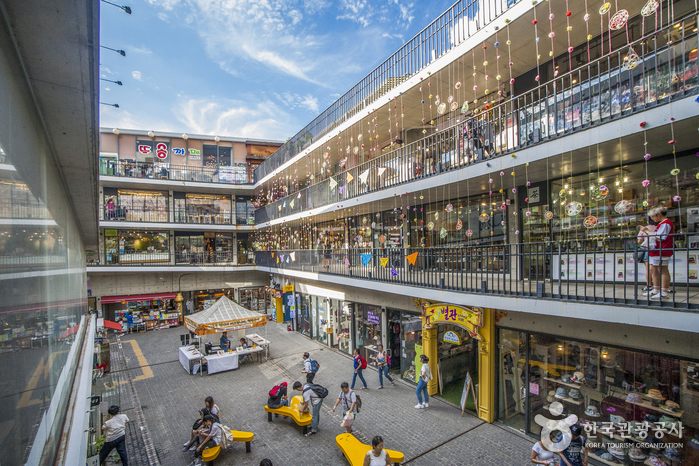
Ssamziegil is Insadong's most distinctive architectural space and one of the best reasons to visit the neighbourhood. Built as a spiral walkway that winds upward around a central open-air courtyard, the building houses around 70 small independent shops selling handmade jewellery, ceramic ware, illustrated prints, hanji (한지) traditional paper goods, indie fashion, and artisan accessories. The design of the space — with each level of shops visible from the courtyard below — creates an atmosphere closer to an arts festival than a shopping mall.
- Hours: 10am–8:30pm daily.
- Admission: Free to enter.
- Tip: The rooftop level has a small performance stage. On weekend afternoons, street musicians and traditional performers often use this space.
- Best for: Unique souvenirs, handmade goods, and photography of the spiral architecture.
Art Galleries Along Insadong-gil
The side streets branching off the main Insadong-gil strip contain dozens of small contemporary and traditional art galleries. Many are free to enter and rotate exhibitions regularly. Galleries here range from established institutions showing Korean ink painting and ceramics to newer spaces focused on contemporary illustration and digital art. Even if you do not intend to buy, the galleries are worth browsing as a window into the Seoul art scene beyond the major museums.
The area around Bukchon Hanok Village's southern edge — accessible via a short walk north from Anguk Station — connects naturally with Insadong and is worth including if you have extra time.
Traditional Tea Houses
Insadong is home to some of Seoul's most atmospheric traditional tea houses (찻집, chatsip). Sitting inside a hanok-style wooden building with a cup of ssanghwa-cha (쌍화차, a warming herbal tea made with medicinal roots) or yuja-cha (유자차, citron tea) is one of the most distinctly Korean experiences the neighbourhood offers. Many tea houses are tucked into alleys off the main street — look for wooden signboards and the smell of incense.
- Ssanghwa-cha (쌍화차): Dark, earthy, and warming. Served with a raw egg yolk on top in traditional style.
- Yuja-cha (유자차): A bright, citrusy tea made from preserved yuzu fruit. Sweet and refreshing.
- Omija-cha (오미자차): Five-flavour tea made from schisandra berries. Unusual and memorable.
- Budget: Tea in Insadong typically costs ₩8,000–15,000 per cup. Prices reflect the setting and quality of the experience.
Street Food Along Insadong-gil
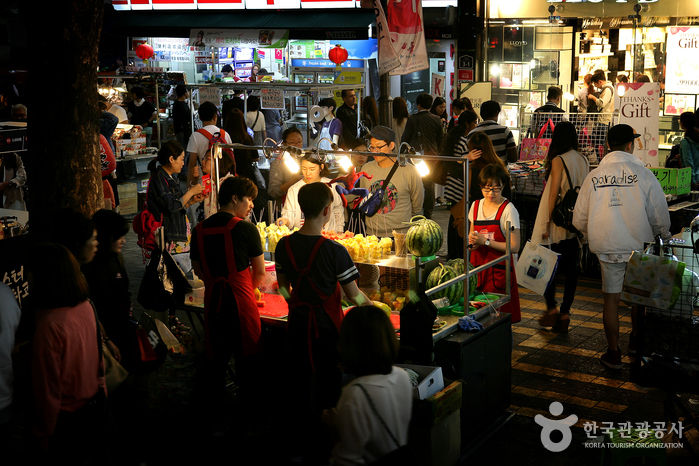
The weekend pedestrian street fills with food stalls that sell some of Seoul's most nostalgic snacks. These are not the trendy fusion items found in Hongdae or Myeongdong — they are traditional and locally beloved.
- Hotteok (호떡): Thick, chewy sweet pancakes filled with brown sugar, cinnamon, and chopped nuts. Best eaten immediately while still hot and slightly crispy on the outside.
- Tteok (떡): Korean rice cakes in dozens of varieties — plain, sesame-coated, filled with sweet red bean paste, or decorated with flower patterns. Insadong's tteok shops are among the best in the city.
- Ssambap (쌈밥): Wrapping rice and side dishes in fresh greens, a wholesome and interactive Korean meal available at several restaurants along the side streets.
- Dalgona (달고나): The honeycomb candy made famous globally by Squid Game. Still sold by street vendors in Insadong — you can try to cut out the shape with a pin just like in the show.
Hanji Paper Shops and Craft Stores
Hanji (한지) — traditional Korean paper made from mulberry bark — has been produced and sold in this neighbourhood for generations. Several dedicated hanji shops remain on Insadong-gil and the surrounding lanes, selling sheets of paper, notebooks, lanterns, fans, and decorative items. Buying a hanji product in Insadong is one of the more meaningful souvenirs you can bring home from Seoul — it is a material with a history stretching back over a thousand years.
Nakwon Arcade (낙원악기상가)
Just north of Tapgol Park at the southern end of Insadong, Nakwon Arcade is one of the most unusual indoor markets in Seoul. It is entirely devoted to musical instruments — hundreds of small shops stacked across several floors selling guitars, drums, Korean traditional instruments (gayageum, haegeum, janggu), brass instruments, synthesisers, and audio equipment. Even if you are not a musician, the sheer density of instruments and the sounds drifting between floors make it a fascinating walk-through.
Tapgol Park (탑골공원)
At the southern entrance to Insadong, Tapgol Park (also known as Pagoda Park) is Korea's first modern public park and a nationally significant historical site. The Wongaksa Pagoda inside the park is a National Treasure. The park is also where the March 1st Independence Movement of 1919 was declared — a pivotal moment in Korean history. It is a sobering and important stop that takes no more than 20–30 minutes.
Best Time to Visit Insadong
Weekends from around 11am to 6pm are when Insadong is at its most vibrant. The car-free street, street performers, food stalls, and full gallery hours all converge during this window. If you prefer fewer crowds, weekday mornings between 10am and noon offer a quieter version of the same neighbourhood with most shops open but far fewer visitors.
Spring (late March to May) and autumn (September to November) are the most pleasant seasons to visit — mild temperatures make the outdoor pedestrian street comfortable, and the neighbourhood's trees are at their most photogenic.
Getting There
Insadong is best accessed via Seoul Metro.
- Anguk Station (안국역), Line 3, Exit 6: This exit deposits you at the northern end of Insadong-gil, the most convenient starting point for the main street and Ssamziegil.
- Jonggak Station (종각역), Line 1, Exit 3: This exit puts you at the southern end near Tapgol Park, good if you want to walk north through the neighbourhood.
- From Myeongdong: Line 4 to Hyehwa → transfer to Line 3 → Anguk (approx. 15 min).
- From Hongdae: Line 2 to Euljiro 3-ga → transfer to Line 3 → Anguk (approx. 20 min).
- From Gangnam: Line 3 direct to Anguk (approx. 25–30 min).
Practical Tips and Budget
- Admission: The street and most galleries are free to enter. Ssamziegil is free. Tapgol Park is free.
- Typical budget: ₩20,000–40,000 covers street food, a traditional tea, and a small hanji or craft souvenir.
- Time needed: 1.5–3 hours for a comfortable visit including Ssamziegil, the main street, and one tea house stop.
- Weekend car-free hours: Insadong-gil is closed to vehicles on weekends. On weekdays the street is open to traffic — the pedestrian experience is notably different.
- Language: Most shop staff in Insadong have basic English. Many shops have English price labels. The neighbourhood is very tourist-friendly.
- Nearby: Bukchon Hanok Village is a 10-minute walk north from Anguk Station and pairs naturally with an Insadong visit for a full cultural half-day.
- T-money card: All metro access uses Seoul's T-money card. Load it at any station convenience store. Standard fare ₩1,400–1,600 per ride.