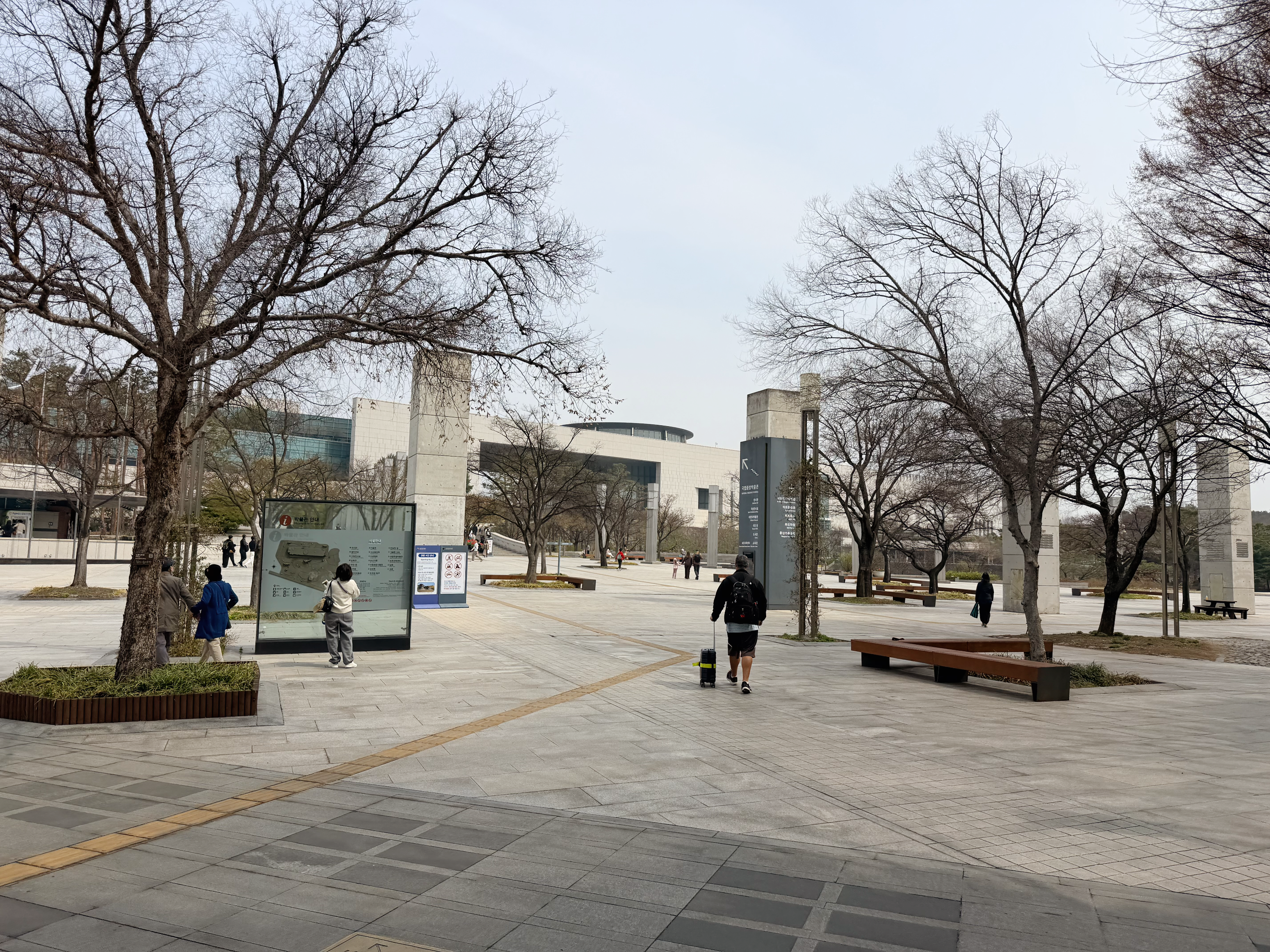
I decided to visit the National Museum of Korea on my own.
Although I’m quite introverted, I actually dislike doing things alone, so this turned out to be a small but meaningful challenge for me. Still, I had been really curious about the museum, and since weekends are known to be very crowded, I made sure to go as early as possible on a weekday.
---
Opening Hours
Mon, Tue: 09:30 – 17:30
Wed, Sat: 09:30 – 21:00
Thu, Fri: 09:30 – 17:30
Sun: 09:30 – 17:30
How to Get There
About a 309-meter walk from Exit 2 of Ichon Station (Line 4 / Gyeongui–Jungang Line), connected via an underground passage.
---

The moment you come out of Exit 2, the museum is right there—and it’s absolutely overwhelming.
The sheer size of the building completely surprised me. I didn’t expect it to be this huge.
The facilities are very well organized, and even from a quick glance, you can tell how massive the place is.

There’s even a spot where you can see Namsan Tower at a glance. Many people were sitting there relaxing, and it looked incredibly peaceful.
On one side, there are cafes like Twosome Place, Ediya Coffee, and even a convenience store.
---

1st Floor: Prehistory & Ancient / Medieval & Early Modern Galleries
The space features very high ceilings with natural light streaming in, creating a warm and calming atmosphere. It really helps you settle into the experience.
“Finally, I’m here!”—that was my first thought.

The layout starts neatly from Gallery 101-1, though if you take a wrong turn, you might end up going backward and retracing your steps (which happened to me a few times). Still, overall, the flow is quite intuitive.
Personally, I found the Paleolithic, Neolithic, and Bronze Age sections a bit less engaging—maybe better suited for kids.

You’ll see the evolutionary timeline from Homo sapiens (about 200,000 years ago) to Homo erectus, and even Australopithecus (about 4 million years ago).

One interesting artifact was a gilt-bronze face-shaped ornament discovered in Jilin, China. It has a loop between the eyes, suggesting it may have been hung or used as a mask.
There were also everyday objects used by the people of Gojoseon.
At this point, I moved on fairly quickly—this section felt like something kids might enjoy more.
---
Joseon Dynasty Gallery (Most Impressive)
This was, by far, the most interesting section for me.
It really made me feel that Joseon was a nation of scholars. The exhibits—filled with textbooks, legal codes, and instructional texts—reflect a culture centered on order, discipline, and moral teachings. The overall atmosphere feels clean, strict, and refined.
Creation of Hangul
In the winter of the Gyehae year, our king created 29 letters of a new script, briefly explaining its principles and presenting it as Hunminjeongeum. The shapes of the letters were modeled after forms, drawing inspiration from classical traditions, and the sounds were organized according to seven phonetic categories.
It encompassed the principles of the three fundamental elements and the subtle workings of li and qi, allowing infinite combinations with just 28 letters. It was simple yet essential, precise yet without obstruction. Therefore, a wise person could master it in a single morning, while even a less capable person could learn it within ten days.
With this script, one could examine legal cases and uncover the truth of their circumstances. In phonology, it allowed distinctions between clear and voiced sounds, and in music, it made it possible to match tones and rhythms. Thus, there was nothing one could not express in writing, and nowhere it could not be understood. Even the sound of the wind, the cry of cranes, the crowing of roosters, or the barking of dogs could all be written down.
Seeing Hangul in its original historical form was deeply moving.
Song of Praise for the Founding of the Joseon Dynasty
Joseon Dynasty, 1447
The first book ever written in Hangeul, Song of Dragons Flying to Heaven is an invaluable resource for studying teh language and literature of the fifteenth century. It consists of an epic song with 125 contos, describing how the Joseon Dynasty was founded by divine providence.
Metal Type (Jeongnija)
King Jeongjo showed great interest in publishing and printing. In 1796, a massive set of about 300,000 metal types was created. Even after a fire destroyed many of them, over 128,000 were recast. Both sets still exist today.
Hangul movable type
Hangul type was created to educate the crown prince and the people.
Since the official writing system of the Joseon Dynasty was Classical Chinese, most movable type produced at the time was based on Chinese characters. However, Hangul type was also made in order to publish vernacular translations of Confucian texts used for educating the crown prince and enlightening the general public. In the 17th century, when new metal type was produced, Hangul metal type was created as well. For books distributed to the people, wooden movable type was mainly used.
King Jeongjo greatly admired and praised the improved type that he had planned and refined.
Genealogy Publication
Recording family lineage.
The practice of honoring ancestors and organizing family lineage existed as early as the Goryeo Dynasty, but it was during the Joseon Dynasty that genealogies began to be widely published. After periods of war, the publication of genealogies increased significantly.
One of the most important figures of the 17th century was Kim Yuk, who proposed the implementation of the Daedong Law and the minting of currency. He was the 14th-generation descendant of the Cheongpung Kim clan, Cheongno Sangjanggun branch. His son, Kim Jwa-myeong, also worked to expand the Daedong Law, while his grandson, Kim Seok-ju, not only created metal movable type known as Hanguja but also played a central role in the factional politics (Hwanguk) during the reign of King Sukjong.
At the time, this family belonged to the Westerners (Seoin) faction, and Kim Seok-ju played a role in its division into the Noron and Soron factions.
Advances in Science and Technology
Providing the people with information about time and the seasons.
Angbuilgu (Hemispherical Sundial)
A sundial used by the general public.
In October 1434 (the 16th year of King Sejong the Great), the hemispherical sundial Angbuilgu was installed in busy public areas of Hanyang, including Hyejeonggyo (near today’s Gwanghwamun Post Office) and the street south of Jongmyo, so that anyone could easily tell the time and the seasons.
It is called Angbuilgu, meaning “bowl looking up at the sky,” because it is shaped like a concave pot facing upward. Inside the bowl, the shadow of a pointed gnomon moves across the inner surface from sunrise to sunset, aligning with horizontal and vertical lines marked within the circle. By observing this position, people could determine both the time and the seasonal divisions.
The horizontal lines represent the 24 seasonal divisions of the traditional calendar, while the vertical lines indicate the hours of the day.
It is remarkable not only that people could tell the time, but also that they were able to understand the seasons and even aspects of the weather.
Cheonsang Yeolcha Bunyajido (Celestial Chart)
Cheonsang Yeolcha Bunyajido is a remarkable star map that represents constellations within a single circular diagram. From the middle-left side, two lines begin separately, merge at the center, and then continue downward—this feature represents the Milky Way, which was traditionally called Cheonhan, meaning a great river flowing across the sky.
Even when reading about it, the complexity of this extraordinary star chart is difficult to fully grasp, leaving one with a deep sense of admiration.
Honil Gangni Yeokdae Gukdo Jido (World Map of Integrated Lands and Regions)
Honil Gangni Yeokdae Gukdo Jido is a world map that reflects the status and perspective of the Joseon Dynasty. It was created by adapting an earlier world map from the Yuan Dynasty of China and adding details of Joseon and Japan. It is considered the oldest surviving world map in East Asia.
On this map, China and Joseon are depicted larger than their actual geographic proportions. This suggests an intention to present Joseon, alongside China, as a culturally advanced and significant nation.
The fact that this is the oldest world map produced in Joseon highlights how the country was not only resilient but also intellectually sophisticated, with a strong foundation in scientific thinking.
Amhaeng-eosa (Secret Royal Inspector) – Mabpae Inscriptions
The text engraved on the front side of the mabpae (horse pass):
One-horse pass (Il-mapae):
Issued by the Royal Secretariat, character Ryeo, one-horse pass, January, first year of the Yongzheng Era.
Two-horse pass (I-mapae):
Issued by the Royal Secretariat, character Suk, two-horse pass, June, eighth year of the Yongzheng Era.
Three-horse pass (Sam-mapae):
Issed by the Royal Secretariat, character O, three-horse pass, March, fourth year of the Tianqi Era.
Four-horse pass (Sa-mapae):
Issued by the Royal Secretariat, character Hwal, four-horse pass, March, fourth year of the Tianqi Era.
Five-horse pass (O-mapae):
Issued by the Royal Secretariat, character Ji, five-horse pass, March, fourth year of the Tianqi Era.
Hopae (Identification Tags by Social Status)
Hopae were identification tags for men aged 16 and older, and their material varied depending on social rank.
Ivory hopae: Officials of rank 2 or higher
Horn hopae: Officials of rank 3 or lower
Wooden hopae: Saengwon and Jinsa (lower-level scholars), as well as commoners
This system clearly reflects the structured hierarchy and social order of the time.
Portrait of Hwang Hui
Portrait of Hwang Hui depicts Hwang Hui, who served as a government official from the reign of King U of Goryeo through that of King Sejong the Great. During King Sejong’s reign, he held all three highest state council positions (Samjeongseung) and served as a chief state councilor for 24 years.
He was widely respected for his gentle and generous character and is often regarded as a model of integrity (Cheongbaekri). However, he was also involved in several controversies related to legal cases concerning his family and associates.
In this portrait, he is shown wearing a light red official robe (damhongpo) and a belt (seodae), reflecting the style of 15th-century official attire.
In addition, the exhibition allows visitors to explore various historical figures and artifacts related to different kings.
Merit Certificate for Founding Contributors
This document is a royal certificate awarding rewards to those who contributed to the founding of a new dynasty. It was issued in 1395, three years after Yi Seong-gye (r. 1392–1398) overthrew Goryeo and established the Joseon Dynasty. The certificate was granted to Yi Hwa-sang (d. 1398), who held the military post of Cheomjeoljesa.
The document records, over 210 lines, the selection of 105 individuals including Yi Hwa-sang as Wonjong Gongsin(meritorious subjects of secondary rank) and details the rewards they received. According to the record, Yi Hwa-sang was granted 30 gyeol of land and three slaves. In addition, his parents and wife were given honorary titles, while his descendants were appointed to government positions.
During the Joseon period, those with direct and outstanding contributions were designated as Jeonghun Gongsin (primary meritorious subjects), while those whose contributions were recognized more broadly were classified as Wonjong Gongsin. The latter group could number in the hundreds or even thousands.
---
Roof Tiles Excavated from the Site of Hoeamsa Temple
Convex roof-end tile (Sumaksae) inscribed with “Hyoryeong Daegun”
(referring to Grand Prince Hyoryeong)
Concave roof-end tile (Ammaksae) inscribed with “Cheonsun Gyeongjin”
(a date corresponding to the Tianshun Era)
Convex roof-end tile (Sumaksae) also inscribed with “Cheonsun Gyeongjin”
Tomb Inscription of Crown Prince Sado
Tomb Inscription of Crown Prince Sado was written by King Yeongjo for his son, Crown Prince Sado, who died after being confined in a rice chest on his father’s orders.
In this inscription, King Yeongjo explains that this unprecedented act was caused by what he describes as Sado’s wrongful behavior. The complex and tragic relationship between King Yeongjo and Crown Prince Sado continues to be examined and reinterpreted in various ways to this day.
---
Goryeo Dynasty
Goryeo Dynasty was the second unified kingdom on the Korean Peninsula, founded in 918.
Jeong Mong-ju and Jeong Do-jeon at a Turning Point in History
Jeong Mong-ju and Jeong Do-jeon were close friends who studied together under the Neo-Confucian scholar Yi Saek in the late Goryeo Dynasty. Sharing common ideals, they worked together to promote reforms within Goryeo.
However, at the critical moment of dynastic change, Jeong Mong-ju chose a different path from Jeong Do-jeon. In March 1392, he was killed and has since been revered as a symbol of loyalty. In contrast, Jeong Do-jeon supported Yi Seong-gyein founding a new dynasty.
During his exile in Naju, Jeong Do-jeon witnessed the hardships of the people and came to envision a system of governance that would serve them. He sought to realize his ideals and political vision through Yi Seong-gye.
Celadon Openwork Incense Burner with Seven-Treasure Motif (13th Century, Goryeo)
Celadon Openwork Incense Burner with Seven-Treasure Motif is composed of a gourd-shaped lid decorated with an openwork (tugak) technique featuring a chilbo (seven-treasure) pattern, and a body shaped like a lotus bud.
The chilbo pattern is a geometric design formed by slightly overlapping circles to create interlinked rings resembling flower petals. It symbolizes various auspicious meanings such as longevity, happiness, wealth, and celebration. The joints of these rings are sometimes inlaid with beads; in this piece, white clay was inserted instead.
At the center of the lid is a long, tube-like opening, allowing incense smoke to rise through it when burned. The body of the incense burner is designed with two overlapping layers of lotus petals, and small white clay dots are applied along the edges of the petals for a decorative effect. The base is also crafted with openwork around the upper section, resembling a railing-like structure.
Bronze Mirror
When you take a quick look into it, your face appears faintly reflected. Interestingly, the reflection can look softer and even more flattering than in a modern mirror, due to the slightly blurred surface.
Uicheon, Leader of the Hwaeom School
Uicheon (1055–1101), honored as Daegak Guksa, was a leading figure in Buddhism during the early Goryeo Dynasty.
He was born as the fourth son of King Munjong of Goryeo (the 11th ruler) and entered monastic life at the age of 11 at Yeongtongsa Temple in Gaegyeong. Within just two years, he rose to the rank of Seungtong, the highest clerical position within the doctrinal (Gyojong) order.
In 1085 (the 2nd year of King Seonjong), he traveled to the Song Dynasty for study, where he gained wide recognition in both Buddhist circles and the imperial court.
Bell Inscribed with “Cheongnyeong 4th Year”
Bell with Cheongnyeong 4 inscription is a bell from the Goryeo Dynasty, discovered in Yeoju, Gyeonggi Province.
An inscription reading “Cheongnyeong 4th year” is engraved on its surface, indicating that the bell was made in 1058. Because it clearly records its production date, it is considered an important historical artifact.
Gold Wing-Shaped Crown Ornament & Conical Crown
The Gold wing-shaped crown ornament is a decorative piece made of gold, crafted in the form of a bird’s wings. It was used as a ceremonial accessory symbolizing a connection to the heavens and royal authority.
The Conical crown is a pointed, cone-shaped headdress. It was typically worn during rituals or ceremonies and served as a symbol of status and power.
These two artifacts are representative examples that illustrate the culture and ceremonial practices of the ruling class in Goguryeo.
While these items belong to an earlier period, it is also true that the later Goryeo Dynasty was strongly influenced by Buddhism. Its advanced metal craftsmanship and elaborate ornamentation reflect not only aesthetic sophistication but also underlying Buddhist values that emphasize restraint and order.
In the 7th century, Baekje and Goguryeo fell, and Silla achieved the unification of the Three Kingdoms, coming to rule most of the Korean Peninsula.
Based on this political stability, culture and the arts flourished with a strong emphasis on Buddhism, leading to the development of the refined and harmonious culture unique to Unified Silla.
Brick with Four Guardian Kings (Sacheonwangsang Jeondol)
Brick with Four Guardian Kings is a brick made during the Unified Silla period. It features images of the Four Guardian Kings, who protect the Buddhist law. These bricks were used to decorate and safeguard temples and pagodas, serving both a symbolic and protective function.
Balhae was a state founded by Dae Joyeong and former Goguryeo people. It developed across Manchuria and the northern Korean Peninsula, forming a distinct culture based on Buddhism and active foreign relations.
Timeline Overview
600s: Baekje and Goguryeo fall; Unified Silla completes the unification of the Three Kingdoms.
700s: Foundation of Balhae by Dae Joyeong; peak of Unified Silla; flourishing of Buddhist culture.
800s: Internal instability in Unified Silla begins (aristocratic conflicts and regional rebellions); rise of powerful local warlords (hojok).
900s: Founding of Later Baekje by Gyeon Hwon and Later Goguryeo by Gung Ye, marking the beginning of the Later Three Kingdoms period.
2nd Floor: “Room of Quiet Contemplation”
This space houses two famous Pensive Bodhisattva statues.
You walk through a dark tunnel, and suddenly—there they are.
The reveal is stunning.
The atmosphere is almost transcendent. Even though it’s not strictly a religious exhibit, the presentation creates a deeply emotional and reflective experience.
Art & Calligraphy
Amitabha Buddha Preaching in the Pure Land (1831, Joseon)
Amitabha Buddha Preaching in the Pure Land
This painting depicts Amitabha Buddha delivering a sermon in the Western Pure Land (Sukhavati). Amitabha is believed to grant infinite life and light, presiding over a realm filled only with peace and bliss.
Surrounding Amitabha are the Eight Great Bodhisattvas, the Ten Disciples, Gandharvas wearing lion crowns, Yakshaswearing elephant crowns, and the Four Guardian Kings who protect the four directions.
The work was commissioned in 1831 by Princess Myeongon, Princess Bokon, and Princess Deokon—daughters of King Sunjo—who prayed for the longevity and well-being of their parents. It was enshrined at Naewonam Hermitage on Suraksan, a royal prayer site.
The painting was created by five monk-artists, including Gyeonguk and Chegyun, who were active in and around Hanseong (present-day Seoul) and Gyeonggi Province.
Tiger (Joseon, 18th Century, Artist Unknown)
The tiger was a common motif in sejwa-deung (New Year paintings) distributed by the royal court to officials, symbolizing protection against evil spirits.
In this painting, the tiger appears to have suddenly changed direction—its back curves like a drawn bow, and its front legs cross as it moves. This dynamic posture reflects the influence of the chulsanho (descending tiger) motif, which depicts a tiger coming down from the mountains.
The fur is delicately rendered with fine ink lines, each strand carefully drawn, with touches of white added to create a fuller, more textured appearance. The seal and inscription are believed to have been added at a later time.
Monk (by Yun Du-seo, late 17th–early 18th century, Joseon)
The painting depicts an elderly monk, thin and slightly hunched, standing with prayer beads and a staff. Yun Du-seo, known for his interest in figure paintings of Buddhist and Daoist subjects, created many works featuring monks.
In this piece, the aged monk’s body is rendered with fine, delicate lines, conveying frailty and restraint. In contrast, the monk’s robe is depicted with rough, bold ink strokes, adding a sense of weight and presence. Through this balance of subtle and expressive techniques, the solemn and tranquil atmosphere of a devoted practitioner is naturally conveyed.
Bodhidharma (Dalma)
Bodhidharma (Kim Myeong-guk) by Kim Myeong-guk (17th century)
This painting depicts Bodhidharma, the founding patriarch of Zen (Seon) Buddhism. Bodhidharma is a frequent subject in Zen painting, and this work is considered one of Kim Myeong-guk’s representative pieces.
His distinctive, foreign appearance is emphasized through arched eyebrows, wide-open eyes, and a thick, unkempt beard. With swift and bold brushstrokes and minimal lines, the artist conveys a powerful sense of energy and vitality.
It is believed that this work was left in Japan after Kim Myeong-guk traveled there as a court painter accompanying a diplomatic mission.
They displayed a comparison between photographs of the actual sites and paintings depicting those same locations.
Chongseokjeong
Chongseokjeong is a steep cliffside path located near the entrance from Goseong to Tongcheon in Gangwon Province, North Korea. It features rounded rock formations close to the sea, where waves crash against the shore. The path is notably narrow and rugged, making it a challenging route to pass through.
Bulgyeongdae
Bulgyeongdae is located north of the pass between Yujeomsa and Songnimsa. It marks the boundary between Inner Geumgang and Outer Geumgang and is a scenic spot where visitors can view the famous Sibip (Twelve) Waterfalls, one of the four major waterfalls of Mount Geumgang.
There are so many artworks that it’s hard to keep up with viewing them all.
There are also many beautifully crafted pieces of furniture on display.
Lacquered Box with Mother-of-Pearl and Tortoiseshell (Lotus Arabesque Design)
Joseon, 18th century
Lacquered box with mother-of-pearl and tortoiseshell
This piece follows the form and decorative style of gyeongham (sutra boxes) from the Goryeo Dynasty. Thin metal wires are used to divide sections, which are then inlaid with mother-of-pearl and tortoiseshell cut into patterns such as lotus flowers, chrysanthemums, beads, and diamond shapes.
Although a variety of motifs are applied within a relatively small surface, they are arranged in a balanced and harmonious way, avoiding a sense of clutter while maintaining visual richness.
Comb Case (Bitjeop)
Bitjeop (comb case) is a storage box used to keep combs, hair accessories, and cosmetic items. The interior typically includes multiple drawers to organize various grooming tools.
Some designs also feature a compartment at the top for storing a mirror. Women’s comb cases were often decorated with mother-of-pearl (najeon) or hwagak (ox-horn inlay), giving them a bright and elegant appearance.
Lacquered Chest with Mother-of-Pearl (Landscape & Tortoiseshell Pattern)
Joseon, 19th–early 20th century
Lacquered chest with mother-of-pearl landscape and tortoiseshell pattern.
Lacquered Clothing Chest with Mother-of-Pearl (Plum Blossom & Lotus Arabesque Design)
Joseon, 17th–18th century
Lacquered clothing chest with mother-of-pearl plum blossom and lotus design.
During the Joseon Dynasty, influenced by Confucian ethical values, living spaces for men and women were separated into areas such as the sarangbang (men’s quarters), anbang (women’s quarters), and the kitchen, and wooden furniture suited to each space was used accordingly. Most of these wooden furnishings were made small and simple, taking into account the narrow interiors and low ceilings of traditional Korean houses (hanok).
Donation Gallery & Miscellaneous
From this point on, there was so much to see that I just skimmed through it. Instead, I took a few photos of the pieces that caught my eye.
Norigae - traditional Korean decorative pendant.
Jade Book for Posthumous Honorific Title of Queen Cheorin, Consort of King Cheoljong
Daehan Empire, 1908
This jade book contains the text of the royal decree that conferred the posthumous title “Jang Hwanghu” (Empress Jang) upon Queen Cheorin (1837–1878*). In 1908, Emperor Sunjong elevated the posthumous title of King Cheoljong (r. 1849–1863), the 25th king of Joseon, to “Jang Hwangje” (Emperor Jang), and accordingly, Queen Cheorin’s posthumous title was also raised to “Jang Hwanghu” (Empress Jang).
Royal Jade Seal of Empress Myeongseong (1921)
This jade seal was presented on March 9, 1921, when the honorific title “Jehuiryeolmok” was added to Empress Myeongseong (1851–1895). It is engraved with the inscription.
The titles Hyoja, Wonseong, Jeonghwa, Hapcheon, Honggong, and Seongdeok were honorific titles granted in 1872, 1888, 1890, 1900, and 1901 respectively. “Myeongseong” was the posthumous name conferred in 1897, and “Taehu” refers to the title of empress dowager granted in 1907.
Thousand Character Classic handwritten by Yi Hangbok
Written by Yi Hangbok (1556–1618), Joseon Dynasty, 1607
This Thousand Character Classic was written by Yi Hangbok for his six-year-old grandson, Simyeong (1602–1657). It is considered the oldest surviving handwritten edition of the Thousand Character Classic in Korea. Each character, written carefully in regular script (haeseo), shows a firm structure and sharp, refined brushstrokes.
The Korean annotations of pronunciation and meaning written beneath the Chinese characters are of uncertain authorship. At the very end of the book, there is a message of advice addressed to his grandson.
3rd Floor (Missed Highlight)
By the time I got here, I was exhausted and my phone battery had died, so I left early.
Later, I found out that a bronze helmet from ancient Greece is displayed here—definitely a reason to come back.
---
Final Thoughts
1st Floor
Takes much longer than expected—at least an hour. Easy to lose track of time. The Joseon gallery stands out the most to me.
2nd Floor
The “Room of Quiet Contemplation” is unforgettable. It encourages deep reflection, especially during quieter weekday hours.
3rd Floor
Worth dedicating more time on a future visit, especially for rare artifacts like the Greek bronze helmet.
---
The National Museum of Korea is a place where you can easily spend 3 hours—even alone.
It’s almost surprising that I’m only discovering it now. Definitely a place worth visiting more than once.