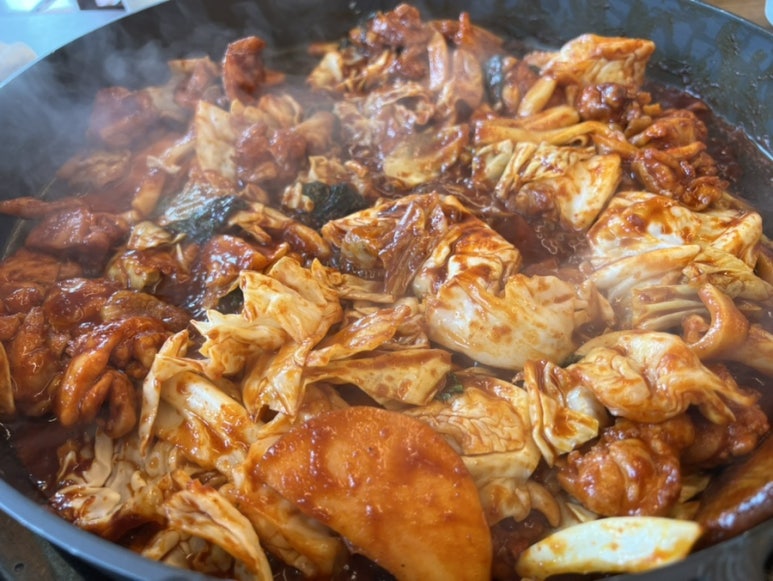
Dakgalbi (dakgalbi, 닭갈비) came to Seoul as an outsider. It was born in Chuncheon — a city two hours northeast of the capital, best known internationally as the setting of the K-drama Winter Sonata and the filming location that launched the original Korean Wave in the early 2000s. In Chuncheon, dakgalbi shops line entire streets, and locals will tell you with quiet pride that nowhere else does it right. They are not entirely wrong. But Seoul adopted dakgalbi so thoroughly that you can now find excellent versions in Jongno, Hongdae, and Kondae (Konkuk University area) — and the ritual around eating it, the sizzling iron pan at your table and the fried rice at the end, is now as Seoul as it is Chuncheon. This guide will get you through both the dish and the ceremony.
Types of Dakgalbi You Should Know
The core concept is consistent: marinated chicken thigh cooked in a spicy gochujang (고추장) and gochugaru (고추가루) sauce with sweet potato, cabbage, green onion, and tteok (rice cake pieces). But the cooking method splits into two distinct styles.
- Cheolpan Dakgalbi (철판닭갈비) — Iron Pan Dakgalbi — The most common Seoul version. A large round iron griddle arrives at your table, the chicken and vegetables are dumped on in a heap, and you watch (or help) as the server works everything together over a gas flame. The sauce caramelises at the edges of the pan, the tteok goes slightly crispy on one side, and the whole table smells like roasted chilli and garlic. This is the interactive, communal, slightly chaotic version of dakgalbi.
- Sutbul Dakgalbi (숯불닭갈비) — Charcoal Dakgalbi — The original Chuncheon method and considered by many to be the premium version. Chicken pieces marinated in the same spicy sauce are grilled directly over charcoal rather than stir-fried on an iron pan. The charcoal adds a smoky depth that the iron pan cannot replicate. Slightly drier texture, more distinct char on the chicken. Fewer Seoul restaurants do this version well — look for restaurants that specify 숯불 in their name.
- Mul Dakgalbi (물닭갈비) — Water / Broth Dakgalbi — A completely different animal. Instead of a dry stir-fry, the chicken is cooked in a spicy broth that becomes a kind of thick soup-stew. Milder than the standard version and much more accessible for people with lower spice tolerance. "Mul" means water, and the dish is indeed wetter, more saucy, and arguably easier to eat. If you are worried about spice level, this is your starting point.
- Cheese Dakgalbi (치즈닭갈비) — A modern variation where a cup of melted mozzarella is set in the centre of the iron pan. You drag each piece of spicy chicken through the cheese before eating, which mellows the heat and adds richness. Popular with younger diners and widely available in Hongdae-area restaurants. Worth trying at least once.
How to Order and Eat Dakgalbi
Most dakgalbi restaurants price by portion for two people (2인분, i-inbun) as the minimum order, though larger groups simply order more portions. The menu is usually simple: choose your style (iron pan or charcoal), choose your spice level if options are given, and decide on sari (사리) additions.
Sari are add-ins that go into the pan alongside the chicken. The most popular are:
- Ramyeon Sari (라면사리) — Instant noodles cooked directly in the pan. They absorb the spicy sauce as they cook and become the perfect vehicle for the leftover liquid at the end.
- Tteok Sari (떡사리) — Extra rice cake pieces. If you love the slightly chewy, crispy-edged tteok in the base dish, order more.
- Jjolmyeon Sari (쫄면사리) — Chewy cold noodles added to the hot pan — an unusual texture contrast that works surprisingly well.
- Mandu Sari (만두사리) — Dumplings, which absorb sauce as they cook and become incredibly rich.
The sequence of eating dakgalbi has an unspoken but widely followed order. First, eat the chicken and vegetables while everything is at its hottest and most flavourful. Then add your sari and let it cook in the remaining sauce for a few minutes. Then — and this is the ritual everyone talks about — order bokkeum-bap (볶음밥).
Bokkeum-bap is fried rice made directly in the same pan you have been eating from. The server (or you, if you are confident) adds rice, sesame oil, and sometimes seaweed flakes to the residual sauce coating the bottom of the pan, then mixes and presses it into a thin fried rice cake. It is then divided into portions and eaten from the pan. It is smoky, spicy, and caramelised from all the sauce that built up during the meal. Korean dakgalbi regulars will tell you: skipping the bokkeum-bap is like leaving a concert before the encore. The meal is not finished without it.
Where to Find Dakgalbi in Seoul
The most tourist-accessible dakgalbi areas in Seoul cluster around three neighbourhoods.
Jongno / Gwanghwamun is where you find well-established restaurants catering to both office workers and visitors near the palace area. Seochon Dakgalbi Gwanghwamun Branch (서촌닭갈비 광화문본점) in Jongno-gu is one of the better-known names in this area — centrally located and easy to reach from the major tourist corridors.
Hongdae and Mapo (including Mapo-gu) are home to several dakgalbi spots popular with the younger crowd and post-concert diners after K-pop events at nearby venues. Yugane Dakgalbi Hongdae 2nd Branch (유가네닭갈비 홍대2호점) is a reliable chain with an English-friendly menu and clear instructions for first-timers.
Konkuk University (건대) area in Gwangjin-gu is arguably the best neighbourhood in Seoul for dakgalbi per square metre — multiple specialist restaurants, competitive pricing, and a lively student atmosphere that matches the dish's communal energy. Jangin Dakgalbi Konkuk Branch (장인닭갈비 건대점) is one of the standout spots there. Also in Gwangjin-gu, Arang-yeok Mul Dakgalbi Seoul Main Branch (아랜역물닭갈비 서울본점) specialises in the broth version for those who want a milder introduction.
Is Chuncheon Worth the Day Trip?
If you have an extra day and a particular devotion to dakgalbi, yes. Chuncheon is about 70–80 minutes from Seoul on the ITX-Cheongchun train (청춘선) from Yongsan Station. The city's famous Dakgalbi Street (Dakgalbi Golmok, 닭갈비골목) near Chuncheon Station has dozens of restaurants that have been operating for decades, some since the dish was invented here in the 1960s. The charcoal version is more commonly available there than in Seoul. Pair it with a walk along Uiam Lake and you have a genuinely excellent day outside the capital.
Price Guide
In Seoul, a standard iron pan dakgalbi portion for two people runs ₩16,000–₩22,000. Sari additions cost ₩1,000–₩3,000 each. Bokkeum-bap (fried rice finish) is usually ₩2,000–₩3,000 extra and absolutely worth ordering. Budget roughly ₩15,000–₩20,000 per person for a full dakgalbi meal with sari and bokkeum-bap. Charcoal versions tend to run slightly higher, around ₩20,000–₩28,000 for two. Cheese dakgalbi adds approximately ₩3,000–₩5,000 to the base price.
Tips for First-Timers
- Order bokkeum-bap. Save room for it. It sounds like an afterthought but it is the point most regulars look forward to most. If the server asks at the end of the meal, say yes.
- Spice level matters. Standard dakgalbi is genuinely spicy — not novelty-spicy, but the kind that builds heat over the course of the meal. If your spice tolerance is low, ask for 순한 맛 (sunhan mat, mild) or order the mul version.
- Minimum two people for most restaurants. Dakgalbi is designed as a shared dish — single diners will find limited options. If you are travelling solo, look for restaurants that explicitly advertise 1인 식사 가능 (solo dining available).
- The pan gets very hot. Iron pan versions heat the entire surface of the table burner to high temperature. Keep hands clear of the pan edges and let the server handle the initial mixing if offered.
- Cheese dakgalbi in Hongdae is a good entry point if the standard spice level concerns you — the melted mozzarella softens both the heat and the intensity, and the restaurants in the area are well-practised at serving first-time visitors.