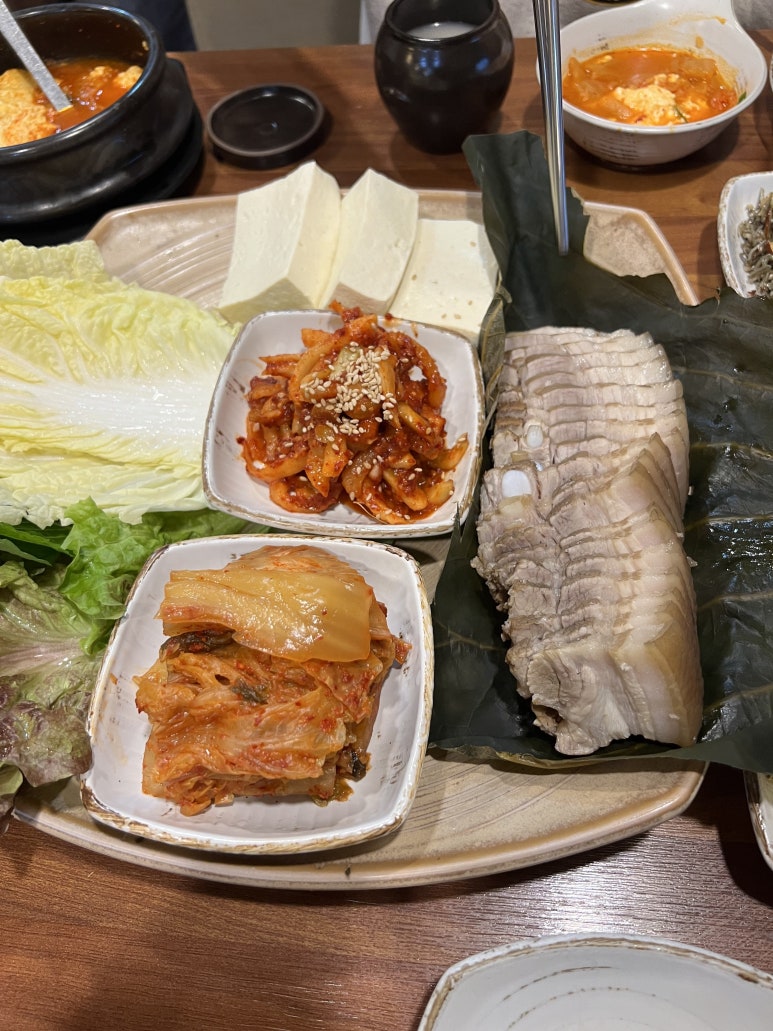
In Reply 1988, when a family moves into the neighbourhood, they bring bossam (bossam, 보쌈). Not cake, not wine — bossam. Boiled pork belly, a pile of napa cabbage leaves, kimchi, and oysters. It is the gift you bring when you want to say: welcome, sit down, let us eat together. That is what bossam means in Korea — it is feast food, communal food, the kind of dish that appears at family gatherings, moving days, and autumn celebrations when oysters come into season. Jokbal (jokbal, 족발), on the other hand, shows up alone, at midnight, delivered to a small apartment where someone is watching a drama and does not want to cook. It is the late-night companion, the comfort order, the food that appears in K-drama "sad eating" scenes more reliably than any other. Two dishes, one pig, completely different stories. This guide covers both.
Bossam vs Jokbal: Understanding the Difference
They share a menu and often a restaurant, but bossam and jokbal are distinct dishes with different preparations, textures, and eating rituals.
- Bossam (보쌈) — Boiled Pork Belly — Pork belly and sometimes shoulder is simmered for hours in a broth seasoned with doenjang (fermented soybean paste), ginger, garlic, green onion, and spices until the meat is completely tender and pulls apart with gentle pressure. It is then sliced and served at room temperature or slightly warm, alongside napa cabbage leaves, fermented kimchi, salted shrimp (saeujeot, 새우젓), and ssam jang (쌈장, spicy fermented paste). You wrap a piece of pork in a cabbage leaf with a dab of each condiment and eat it in one or two bites. The boiling method makes the pork exceptionally soft — not the caramelised char of samgyeopsal, but a gentle, yielding tenderness that is something else entirely.
- Jokbal (족발) — Braised Pig's Trotters — Pig's feet (trotters) slow-braised in soy sauce, rice wine, ginger, garlic, and aromatics until the skin becomes deeply glossy, almost lacquered, and the meat between the bones is pull-apart tender. The result is rich and intensely savoury, with a gelatinous quality from the collagen in the skin that is either deeply satisfying or requires some adjustment depending on your experience with this texture. Jokbal is served sliced, often on a bed of shredded cabbage, with the same ssam jang and saeujeot accompaniments as bossam, plus sliced raw garlic and chilli.
The reason these two dishes appear on the same menu — and the same delivery app — is partly practical (a restaurant that braises pork all day can easily do both cuts) and partly cultural: they are natural companions for a table of people who want to try both. Many restaurants sell combination sets (bossam-jokbal set) explicitly for this purpose.
How to Eat Bossam: The Wrap Method
Eating bossam well is about the assembly. A poorly constructed wrap falls apart before it reaches your mouth; a well-made one delivers every element in a single harmonious bite.
Start with a napa cabbage leaf (baechu, 배추) or sometimes a perilla leaf (kkaennip, 깻잎) as your base. Lay a slice or two of pork in the centre — not too large. Add a small amount of ssam jang with the back of a chopstick. Then the critical additions: a small piece of raw kimchi (use the aged, well-fermented kind rather than fresh), and — if it is autumn or winter — a fresh oyster. The oyster is not a garnish; it is structural to the flavour. Its briny, mineral quality cuts through the richness of the pork in a way that is difficult to describe until you have tried it. Add a pinch of saeujeot (salted shrimp) if you want extra salt and umami. Fold the leaf over everything and eat in one or two bites. Do not overthink the wrap — Koreans make this look effortless because they have been doing it since childhood.
Jokbal: Front Trotter vs Rear Trotter
At specialist jokbal restaurants, the menu distinguishes between ap-jokbal (앞족발, front trotters) and dwi-jokbal (뒷족발, rear trotters). The front legs are smaller, have more tendon, and are considered to have a chewier, more elastic texture — prized by those who like the gelatinous quality of the skin. The rear legs are meatier with a higher ratio of lean pork to skin. Most restaurants serve rear trotters by default unless specified, and for first-timers, that is the easier starting point. Some restaurants also offer bul-jokbal (불족발) — grilled or flame-finished jokbal that adds a caramelised char to the braised surface, giving you the richness of the braise plus the texture of something grilled.
The Late-Night Delivery Culture
If bossam is the celebration dish, jokbal is the delivery dish. In Seoul, jokbal delivery operates until well past midnight — it is genuinely one of the foods Koreans order when they cannot sleep, when they are stress-eating through a drama, when a group of friends decides at 11 PM that the evening needs one more thing. This is not a fringe behaviour; it is mainstream enough that "jokbal delivery" is a recognisable cultural trope in K-dramas. The combination that typically arrives: jokbal, a portion of bossam, cold buckwheat noodles (mul naengmyeon, 물냉면) as a palate cleanser, and makgeolli or beer. At a restaurant, you would order the same combination and add a plate of kimchi. The naengmyeon is not an afterthought — its cold, slightly tart broth genuinely resets the palate between bites of rich pork.
Seasonal Bossam: The Oyster Edition
Bossam changes character with the seasons, and autumn is when it peaks. From October through February, when oysters are at their fattest and most flavourful, restaurants add fresh oysters to the bossam table — sometimes a small bowl on the side, sometimes already layered into the kimchi. The combination of rich boiled pork, aged kimchi, and fresh oyster is one of those seasonal food experiences that Korean food writers describe almost reverently. If you visit Seoul between October and February, ordering bossam with oysters (gul bossam, 굴보쌈) is worth planning around.
Where to Find Bossam and Jokbal in Seoul
Unlike dakgalbi or tteokbokki, bossam and jokbal restaurants tend to be quieter, neighbourhood establishments rather than flashy tourist-facing spots. The best ones are often the places that have been doing exactly the same thing for twenty or thirty years.
The Jang充-dong Jokbal Street (장충동 족발골목) near Dongguk University Station is Seoul's most famous jokbal destination — a cluster of restaurants that have been operating since the 1960s, where the braising recipes have been passed down through families. It is a short walk from Dongguk University Station on Line 3 and worth visiting for the atmosphere alone.
For bossam specifically, older pojangmacha-style restaurants in the Euljiro and Jongno areas tend to offer the best value and most authentic experience — the kind of places where the pork has been boiling since morning and the kimchi has been fermenting for months. Look for restaurants with handwritten menus and long queues of office workers at lunch.
For a more accessible introduction, specialist bossam-jokbal restaurants are found across every major neighbourhood. Ogane Jokbal (오가네족발) in Seocho-gu and spots in the Gwangjin-gu area around Konkuk University offer sit-down bossam and jokbal with English-friendly menus at approachable prices.
Price Guide
Bossam is typically priced by portion size. A small bossam portion (소, so) feeding two people costs around ₩22,000–₩30,000; a medium portion (중, jung) for three to four people runs ₩35,000–₩50,000. Jokbal is similarly structured — a small portion starts around ₩25,000. Combination bossam-jokbal sets usually offer better value than ordering separately and cost ₩35,000–₩55,000 depending on size. Budget ₩15,000–₩20,000 per person at a sit-down restaurant when ordering one of each with drinks and side dishes. Delivery apps price similarly but add delivery fees of ₩2,000–₩4,000.
Tips for First-Timers
- The oyster is not optional in autumn. If you visit between October and February, order gul bossam (굴보쌈) with fresh oysters. It transforms the dish from good to exceptional. If raw oysters concern you, set one aside first and try the pork-kimchi-wrap combination before adding the oyster.
- Saeujeot is saltier than it looks. The small dish of salted shrimp (새우젓) is intensely concentrated — use a tiny amount in your wrap. More than a pinch and it overwhelms everything else.
- Order naengmyeon alongside. Cold buckwheat noodles with jokbal are the traditional pairing for good reason — the cold, slightly sour broth cuts the richness of the pork and resets your appetite between rounds. ₩8,000–₩12,000 extra and genuinely worth it.
- Jokbal texture is collagen-forward. The glossy, slightly gelatinous skin is prized in Korean food culture. If this texture is unfamiliar, start with the rear trotter (뒷족발) which has a higher meat ratio, and taste the skin separately before deciding how much you enjoy it.
- Jangchung-dong for the real experience. If you have time for only one dedicated jokbal outing in Seoul, the Jangchung-dong Jokbal Street is the right destination — the age of the restaurants and the consistency of the recipes give you a version of the dish that a generic restaurant cannot replicate.