Places to Visit
A low, small circular-crater oreum facing the larger Darangshi, its name meaning 'the lesser one' in Jeju dialect, climbed in about ten minutes and beautiful in autumn when tall silver grass ripples in the wind.
There is nowhere else in Korea quite like Jeju. Born from the sea in a slow storm of lava and ash, the island is essentially one enormous volcano — Hallasan (한라산), the country's highest peak — ringed by some 360 smaller cones, threaded with lava tubes, and edged by cliffs of hexagonal basalt so geometric they look almost man-made. UNESCO has honoured it three times over, as a World Natural Heritage site, a Biosphere Reserve and a Global Geopark, and once you start walking here the reason is obvious: every waterfall, grassy hill, forest and black-rock shoreline is a page from the same volcanic story. This guide is for travellers who come to Jeju for the outdoors — less for the cafes and duty-free malls, more for the falls, the oreum, the forests and the coast.
A quick word on logistics before you lace up. Jeju rewards a rental car above all else; public buses reach the headline sights but turn a full day of nature-hopping into a test of patience. It helps to picture the island in two halves: Jeju City and the north coast, where you'll likely land, and Seogwipo and the south, where most of the waterfalls tumble. Two unhurried days — one per side — is the sweet spot. Now, to the good part.
Chasing Waterfalls in Seogwipo
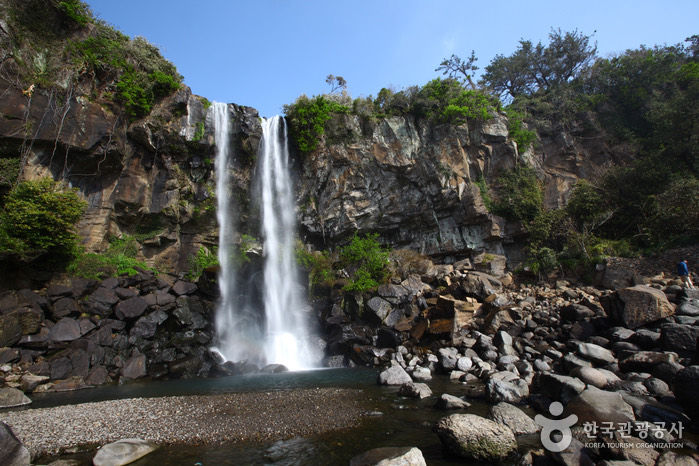
Jeju's waterfalls cluster almost entirely along the southern coast around Seogwipo, and there's a geological reason for it. The porous volcanic rock that makes up most of the island simply drinks rainwater and lets it vanish underground — but Seogwipo sits on a band of harder, less permeable rock, so streams stay on the surface long enough to reach the sea and drop over its cliffs. The result is a rare thing: waterfalls that pour almost directly onto the shoreline.
The Big Three
Start with the classics, all within a short drive of central Seogwipo. Cheonjiyeon Falls is the most accessible — a gentle, paved 20-minute walk through a lush subtropical gorge leads to a broad curtain of water crashing into a deep emerald pool. It's one of the few falls that can sometimes be visited after dark on lit evenings, so check current hours if a night stroll appeals. Jeongbang Falls is the showstopper: one of the very few waterfalls in Asia that plunges straight into the ocean, its white column framed by cliffs and open sea. And Cheonjeyeon Falls, tucked inside the Jungmun resort area, is really a three-tiered chain of pools spanned by the ornate Seonimgyo bridge — do the full loop to see all three drops. Each carries a small admission of a few thousand won, and the three are easy to string together in a single half-day.
Hidden Falls Worth the Detour
The ones locals love take a little more effort. Eongtto Falls is Jeju's phantom waterfall: for most of the year its 50-metre cliff sits bone dry, and it only roars to life after heavy rain — roughly 70mm or more in a day. Time it right (a rainy forecast is your friend here) and you'll see something most visitors never do. Sojeongbang Falls, a short way east of Jeongbang along the Olle trail, is a summer ritual for locals who stand under its cool streams to shake off the heat. And for a wilder outing, Donnaeko Wonang Falls rewards a 20-minute walk from the car park with twin cascades tumbling into a startlingly emerald valley pool — bring water shoes in summer.
Climbing Oreum: Jeju's 360 Volcanic Cones
Learn one Jeju word and make it oreum (오름). These are the island's parasitic volcanoes — some 360 small cones that erupted on Hallasan's flanks and now roll across the landscape like green waves. Most take under an hour to climb, reward you with a crater and a panorama, and feel utterly unlike anywhere else in Korea. If you do just one thing outdoors on Jeju, climb an oreum at golden hour.
The Icon
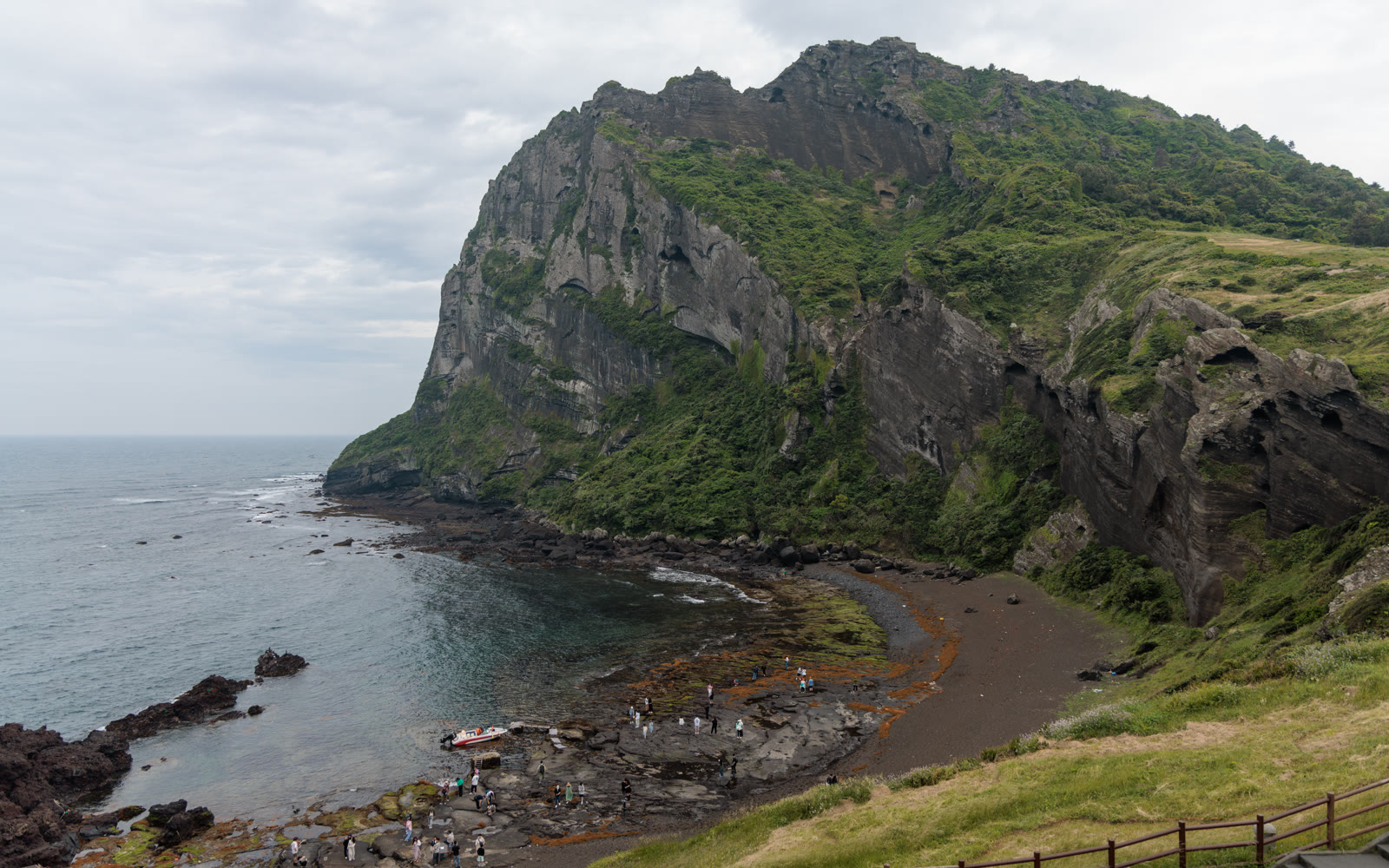
Seongsan Ilchulbong, or "Sunrise Peak," is the one you've seen on postcards — a 180-metre tuff cone that exploded out of the sea in a shallow-water eruption some 5,000 years ago, leaving a vast bowl-shaped crater rimmed with jagged points. The climb is a steep but short stairway, and as the name promises, sunrise from the rim is the classic Jeju moment. A UNESCO World Heritage site in its own right, it pairs naturally with a trip to Udo (more on that below).
Sunrise & Sunset Cones
For photographers, Yongnuni Oreum is a quiet legend: it's said to be the only one of Jeju's roughly 360 cones with three connected craters, its ridgelines curving like a reclining dragon. Saebyeol Oreum — the name means "morning star" — rises in five soft peaks on the western side and turns to a silver sea of swaying eoksae (silver grass) in autumn. And right beside Jeju harbour, Sarabong Oreum offers the city's easiest sunset: its glowing evening view over the water, known as "Sabong Nakjo," is counted among Jeju's ten classic scenes.
Quick Wins
Short on time or travelling with kids? Akkeun Darangshi Oreum is a genuine ten-minute climb to a crater view — maximum reward, minimum sweat. For a nature-lover's detour, Mulyeongari Oreum cradles a rare crater wetland, a Ramsar-listed marsh alive with dragonflies and birdsong. Whichever you pick, wear proper shoes: the trails are grassy and often slick with morning dew.
Hiking Hallasan Without Summiting
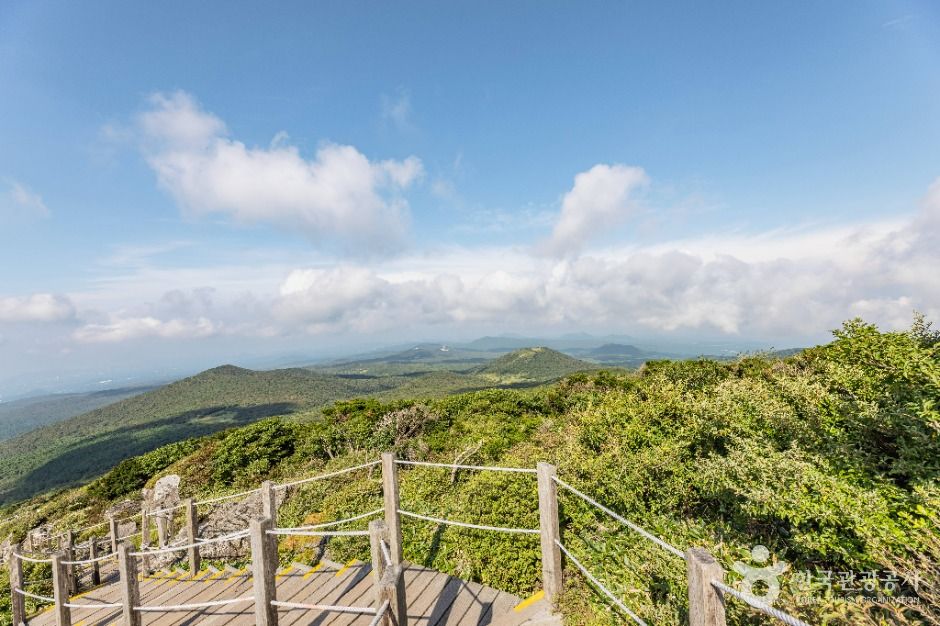
At 1,947 metres, Hallasan is South Korea's highest mountain — but reaching the crater lake at its very top is a long, tightly regulated, all-day commitment, and honestly, it isn't the only way to feel the mountain. Some of Jeju's most beautiful high-country walking happens well below the summit, on shorter trails that still deliver alpine scenery, volcanic ridgelines and clouds drifting below your feet.
Yeongsil — the Beautiful Short Route
If you hike one Hallasan trail, make it Yeongsil. You can drive up to around 1,280 metres before you even start, and the roughly 5.8-kilometre route (about 2.5 hours up) climbs past dramatic rock spires and, in season, slopes of azalea and autumn colour. Koreans nickname it the "beautiful path," and they're not exaggerating.
The Long Way Up
The eastern Seongpanak trail is the long, steady route toward the summit — gentler in gradient but much longer in distance. Note that summit-bound hikes on Hallasan typically require an advance reservation through the official park system and can be closed at short notice for weather; always check ahead and start early. Even if you don't aim for the top, the lower forest sections make a lovely out-and-back.
High-Altitude Wetlands
Above the Yeongsil trail, Witse Oreum is a trio of gentle peaks that serves as the practical turnaround point whenever the summit path is closed — and the views back over the ridge are arguably better than the top. For scenery without the climb, drive the high road to the Eorimok-1100 Highland Wetland, a Ramsar-listed bog at 1,100 metres with an easy boardwalk loop that floats you through misty moorland in minutes.
Coastal Walks & Volcanic Shorelines
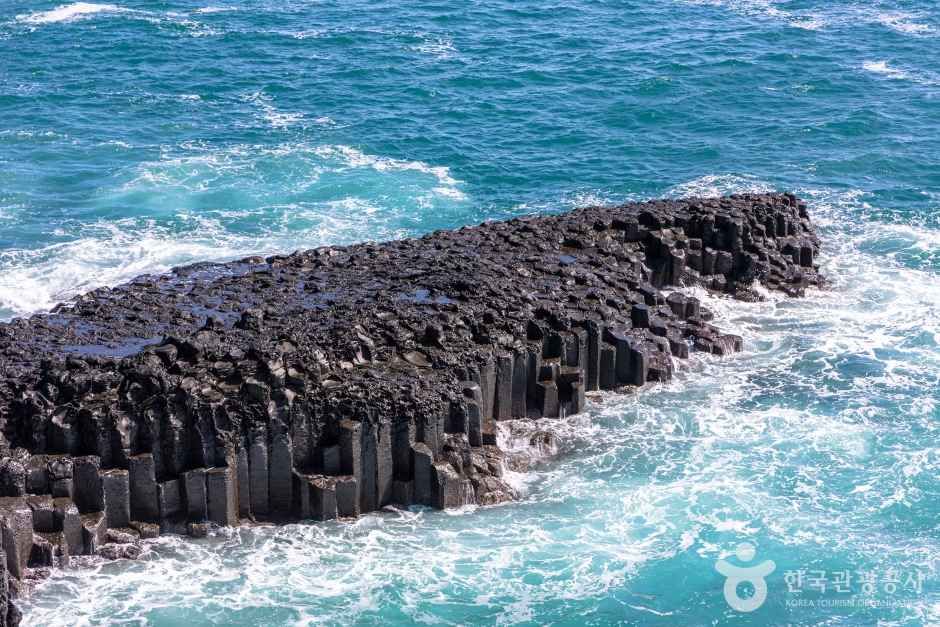
Jeju's coast is a long ribbon of black basalt, and the island has stitched much of it together with the Olle trail network — a beloved system of waymarked coastal walking routes. You don't need to commit to a whole trail; even an hour on the right stretch delivers wind, waves and geology in equal measure.
Geology on Display
The most jaw-dropping stretch is Daepo Jusangjeolli Cliff near Jungmun, where the lava cooled into thousands of near-perfect hexagonal columns — Korea's largest such formation, rising 30 to 40 metres straight from the crashing surf. On the eastern tip, Seopjikoji is a windswept headland of grassy bluffs and an old signal-fire mound, blazing yellow with canola flowers each spring and long woven into Korea's film-and-drama lore. And within minutes of the airport, Yongduam Rock — "Dragon Head Rock," a lava formation carved by wind and waves — makes a perfect first or last stop between flight and hotel.
Cafe-Lined Coastal Roads
Jeju's coastal driving roads are their own attraction, straight out of a K-drama montage. The Woljeongri Coastal Road on the northeast shore pairs a bright turquoise bay with a strip of design cafes — the archetypal Jeju "cafe and sea" afternoon. Over on the northwest, Handam Beach offers a lovely 1.2-kilometre coastal walkway between Aewol and Gwakji, all lava rock and clear water.
Beach-to-Cliff Walks
Hamdeok Beach is the rare Jeju spot where a white-sand, shallow, milky-blue beach sits right beside a climbable cone — Seoubong — with the Olle route running straight through. Come for a swim, then walk up the little oreum for a view back over the water.
Gotjawal & Healing Forests
Here's another word worth knowing: gotjawal (곶자왈). It refers to the tangled forest that grows on top of rugged lava fields — a uniquely Jeju ecosystem where the porous rock keeps temperatures mild year-round, letting northern-limit and southern-limit plant species grow side by side in the same wood. It's the island's green lung, and walking through it feels like stepping into a fairy tale.
What Is Gotjawal?
For an accessible introduction, the Hwasun Gotjawal Eco Trail lays out the concept beautifully, winding over lava rock draped in moss and fern. In summer, Cheongsu Gotjawal becomes one of the island's largest firefly habitats — an unforgettable, near-magical sight on a warm, dark night (go quietly, and skip the flash). For a manicured camellia-forest experience there's Dongbaek Forest, whose namesake blooms turn the garden crimson roughly from late autumn through early spring.
Cedar Therapy
Jeju also does the gentler, "forest-bathing" kind of woodland. Jeju Jeolmul Natural Recreation Forest is the best-loved, with soaring cedar stands and a barrier-free, near-level trail suitable for almost anyone. The restored Halla Ecological Forest gathers the island's native plant zones into one easy-walking park (usually free to enter), while the cypress-lined Secret Forest (Bimil-ui Sup) has become a social-media favourite for its dreamy, light-dappled photos.
Udo: A Volcanic Island Day Trip
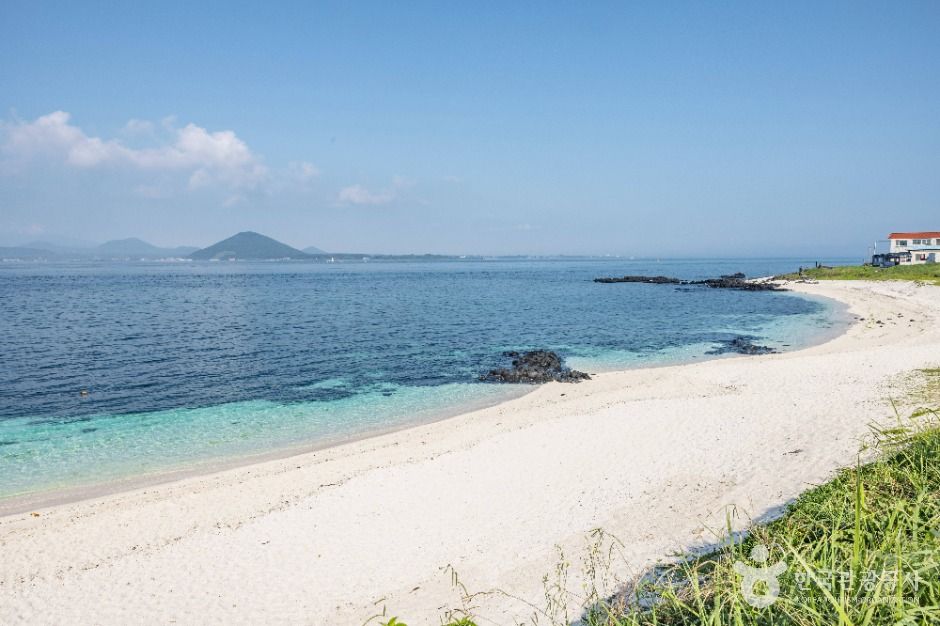
Just off Jeju's eastern tip lies Udo — "Cow Island," named for its resemblance to a reclining cow — and it makes the perfect half-day escape. Ferries run from Seongsan Port in about 15 minutes, which means you can climb Seongsan Ilchulbong at sunrise and be on Udo by mid-morning. Rent an electric scooter or hop the island bus, and a relaxed loop takes three or four hours.
The geological star is Udo Coral Beach (Seobin Baeksa), whose "sand" is not sand at all but bleached fragments of red algae — a rare rhodolith beach that glows an improbable white against turquoise water. For the classic view, climb Someori Oreum (Udobong), the island's single hill, where sea cliffs drop away beneath a lighthouse; the historic Udo Lighthouse here, first lit in 1906, was among the earliest on Jeju. If you simply want to swim and slow down, Hagosudong Beach has the shallow, calm water and soft sand to do exactly that.
Planning Your Jeju Nature Trip
A few practical notes to make it all click into place:
- Rent a car. It's the single biggest upgrade to a Jeju nature trip. Buses work in a pinch, but the distances between oreum, falls and forests eat entire days without your own wheels.
- Split the island in two. Base one day around Jeju City and the north/east (Seongsan, Udo, the coastal roads), and another around Seogwipo and the south (the waterfalls, Jungmun, Yeongsil).
- Let the season steer you. Spring means canola gold at Seopjikoji; summer is for waterfalls and beaches; autumn sets the oreum silver-grass alight at Saebyeol; winter brings camellias at Dongbaek Forest and, on clear cold days, snow on Hallasan.
- Turn bad weather to your advantage. A rainy forecast that would ruin a beach day is exactly when Eongtto Falls comes alive — one of the few sights that's better in the wet.
- Check before you climb. Hallasan summit trails need advance reservations and close for weather, and some oreum enforce seasonal rest periods to protect the grassland — when in doubt, check locally before setting out.
Jeju doesn't ask you to choose between adventure and ease — you can watch the sun rise over a 5,000-year-old crater, wander a moss-draped lava forest, and still be back at a seaside cafe by lunch. Come for the island that K-dramas made you fall for; stay for the volcano you can walk across, one waterfall, oreum and shoreline at a time.