Overview
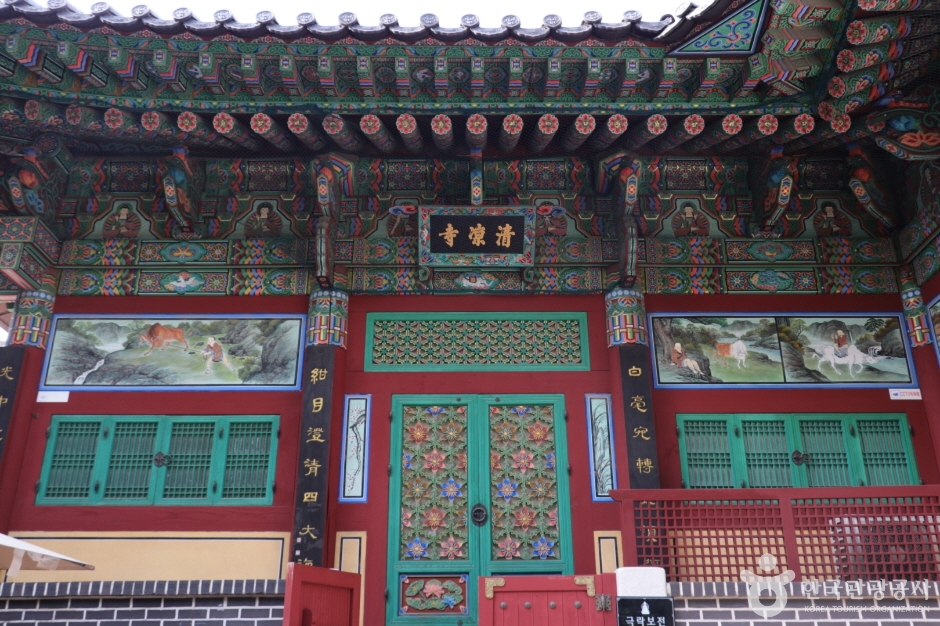
Cheongnyangsa is a Buddhist nun located on the southern foothills of Cheonjangsan. The stone slab monk's hall, famous since ancient times as the temple of the four great nuns, is located here. Originally, Cheongnyangsa and the stone-lined monks were separate temples, but after Empress Myeongseong was assassinated in 1895 due to the Japanese colonial rule of Korea, the empress's mausoleum, Hongneung, was built, Cheongnyangsa Temple, which had been on the site of the red tomb, was moved to its current location. At that time, the stone-studded monks' temple also declined, and the two temples were merged. In the late Joseon period, it was a popular resort destination for people from the capital, and during the difficult times of the Japanese colonial period, it was also a frequent destination for patriots and distinguished monks. In particular, Manhae Han Yong-un, who led the independence and Buddhist movements during the Japanese colonial period, once stayed at Cheongnyangsa, and on July 12, 1939, Han Yong-un's 60th birthday banquet was held here in a modest manner. During the same period, Buddhist scholar Park Han-young also resided at this temple, and the calligraphy on the signboard of Cheongnyangsa Temple hanging in the main hall is believed to be his calligraphy. Entering through the temple's main gate, you immediately see high-rise apartments behind the Gwaneumjeon Hall. Perhaps because it is located in a residential area, Cheongnyangsa operates a daycare center and has a playground for children. The oldest of the Cheongnyangsa buildings, Geungnakbojeon, has a pagoda-like jewel embedded in the center of its roof. Perhaps due to the temple's layout on the slope, the building is densely packed like a duplex structure. Although small, it features temples such as Gwaneumjeon, Muryangsujeon, Daeungjeon, Daebangchae, Seolseondang, and Jeokmukdang.