Things to Do in Jeju
Korea's volcanic island, where you can hike into a crater, stand under a waterfall that drops into the sea, swim off turquoise beaches, and watch the haenyeo women divers work — UNESCO landforms, Olle trails, tea fields and black pork included.

You can read all the numbers about Jeju and still not be ready for it. This is a volcanic island sitting off Korea's southern coast — born from eruptions, ringed by black basalt, crowned by the country's highest mountain — and somewhere in the gap between "subtropical resort island" and "raw geological showpiece" is where the trip actually happens. One coastline glows turquoise over white sand; another is a wall of hexagonal lava columns the sea slams into. You can hike into a crater in the morning and be barefoot on a beach by mid-afternoon.
Here's the thing most first-timers miss: Jeju isn't one destination, it's a ring. The locals split it into east, west, north (around Jeju City) and south (around Seogwipo), and the smart move is to pick a side rather than tear across the whole island chasing a checklist. What ties it all together is the stuff you can't fake — a UNESCO triple-crown of volcanic landforms, the haenyeo (해녀), Jeju's legendary women free-divers, tangerine groves you'll smell before you see, and the Olle (올레) walking trails that thread the entire coast. Below is how we'd actually spend it, sorted by mood, with a half-day-to-full-day flow at the bottom so you can stop planning and start driving.
Volcanic icons
Start with the reason Jeju exists at all. The whole island is one big volcanic monument — so much so that three of its landforms together earned UNESCO World Heritage status, a genuine triple crown. Scattered across the island are some 360 oreum (오름), the small parasitic cones that erupted off the main volcano; once you learn to spot their soft green humps on the horizon, you'll see them everywhere. These are the headliners.
 Seongsan Ilchulbong at sunrise
Why go: "Sunrise Peak" is a tuff cone that exploded straight out of the sea around 5,000 years ago, leaving a giant green crater rimmed like a crown. Climb it at dawn — the name is a promise — and you'll understand why it's the island's signature shot.
 Sangumburi Crater rim
Why go: A rare maar crater — blasted out without lava or ash, so it left a clean two-kilometer bowl in the earth. The walk up is gentle and the payoff is huge, especially in autumn when the silver eulalia grass turns the whole rim to feathers.
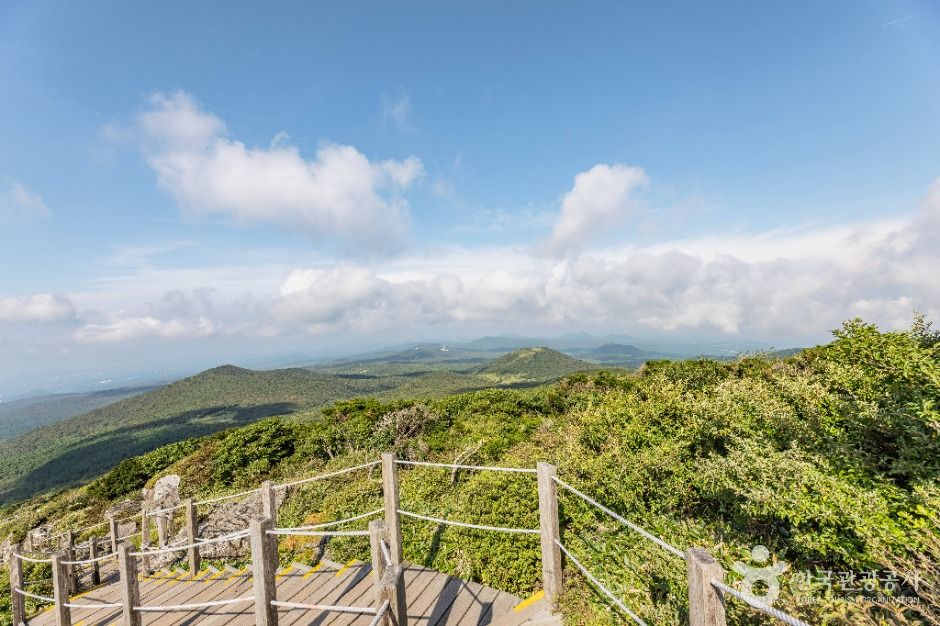 Hallasan, Yeongsil trail
Why go: Hallasan is the dormant shield volcano at the island's center and the highest mountain in South Korea. The Yeongsil route is the shortest and most beautiful way up — rock pinnacles, mountain air, and big views without committing to a summit slog.
If you want the third leg of the UNESCO trio, add Manjanggul (만장굴), one of the world's finest lava tubes — a pitch-dark, cool tunnel carved by flowing lava, complete with a towering lava column near the end. It's a completely different way to read the same volcano: instead of climbing it, you walk inside what it left behind. Bring a layer; it stays cold down there no matter the season.
Waterfalls & dramatic coast
Jeju is one of the only places in Korea where waterfalls pour more or less straight into the sea, and the southern coast around Seogwipo is where that drama concentrates. Pair the falls with the island's most photographed cliff and you've got an afternoon that doesn't quit. Wear shoes you don't mind getting damp.
 Cheonjiyeon Falls at night
Why go: "Sky-meets-land pond" sits at the end of a short, lush walk through a subtropical gorge, the cliff face rising so sheer it does feel staged by something other than people. It's lit at night, which is when locals quietly know to come.
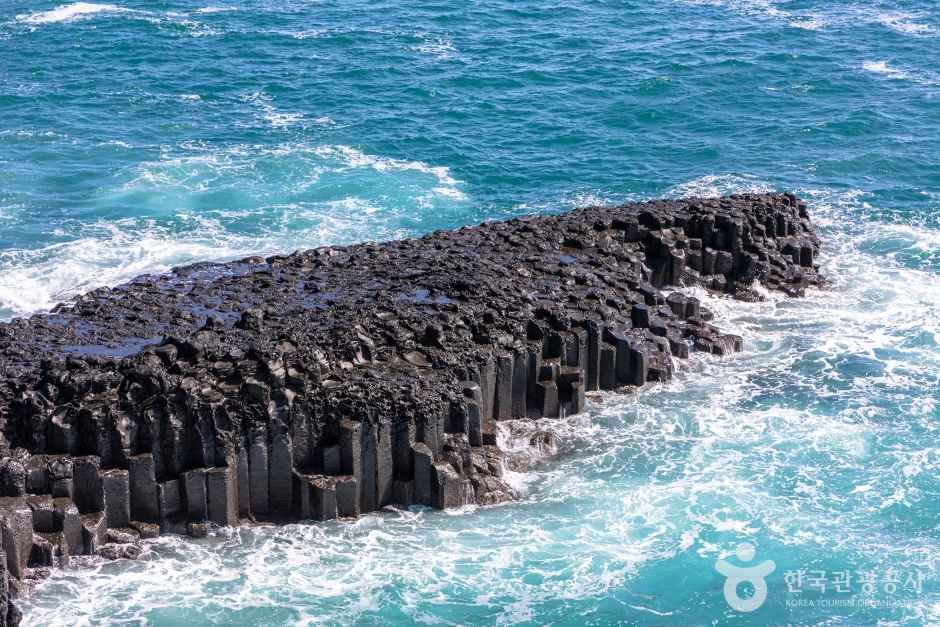 Daepo Jusangjeolli lava columns
Why go: A natural screen of dark, six-sided basalt pillars — cooled lava cracked into near-perfect geometry — with the sea exploding against them below. It looks deliberately carved; it isn't. This is geology showing off.
 Sagye Beach under Sanbangsan
Why go: A small, hushed strand on the southwest coast where you can frame Sanbangsan, Hallasan and the offshore islets all in one look. It's on the Olle Route 10 walk — come for the view and the stillness, not for swimming.
Two more falls round out the set. Jeongbang Falls (정방폭포) is famous for the rare trick of dropping directly into the ocean — stand on the rocks and the spray and the sea are the same water. And Cheonjeyeon Falls (천제연폭포), the "pond of the heavenly emperor," is actually a three-tier cascade reached by a forest walk and the pretty Seonimgyo bridge above it. If it's been raining, all of these run harder and louder, which is the version you want.
Beaches & islands
This is the Jeju that ends up on postcards: impossibly clear water shading from jade to deep blue, white shell-sand, and a scatter of little islands you can hop to by ferry. The water's at its warmest in summer, but the colors show off on any bright day.
 Hamdeok Beach and Seoubong
Why go: Twenty minutes from the airport and yet it stops you cold — shallow, glowing-turquoise water with the little oreum of Seoubong standing guard at one end. It's the easiest "wait, the water is really that color?" moment on the island, and the café-lined backstreets make it a whole afternoon.
 Hallim Park gardens and caves
Why go: A sprawling botanical park right beside the white sands of Hyeopjae Beach, mixing subtropical gardens with a pair of lava caves underfoot. It's the rare spot that keeps both plant nerds and restless kids happy, and it pairs perfectly with a beach hour next door.
For the full island-within-an-island experience, take the 15-minute ferry to Udo (우도, "Cow Island") off the east coast — rent something with wheels and loop a coastline of low cliffs, a famously white coral-sand beach, and a lighthouse, all of it slower and saltier than the mainland of Jeju. Back on the main island, Hyeopjae and Gwakji beaches on the west give you that same electric-blue water with the silhouette of tiny Biyangdo island offshore. And keep an eye out along these coasts for the haenyeo — the women divers, many of them well into their seventies, who still free-dive for shellfish without tanks. It's a living tradition, not a show, and spotting their orange floats bobbing offshore is one of the most authentically Jeju things you can witness.
Forests, tea & gardens
When the coast and the craters have worn you out, Jeju's interior offers the opposite energy: green, quiet, and shaded. The midlands are where you'll find old-growth forest, tangerine country and the tea fields — the slow half of the island, and arguably the part that gets under your skin.
 Secret Forest (Bimil-ui Sup)
Why go: A photogenic stretch of cypress, open meadow, and stone-walled paths in the eastern midlands that blew up on social media for good reason. It's a softer, more curated kind of forest — come for the dreamy frames, stay because it's genuinely peaceful.
Hallim Park subtropical gardenWhy go: Worth a second mention here for its garden side alone — palm-lined avenues, bonsai, a folk village and seasonal flower fields that make it an easy, leafy win when you want shade over surf.
The two interior names to know don't have cards here, but they belong on your map. Bijarim (비자림) is an ancient nutmeg-yew forest in the east where some trees are pushing 800 years old — the air is cool, the path is soft, and walking it feels like dropping the island's volume to a hush. And Osulloc (오설록), out west, is Jeju's famous green-tea estate: rolling rows of tea plants, a sleek tea museum, and the chance to drink a matcha latte looking out over the field it came from. Jeju's volcanic soil and mild climate are why tea (and those sweet little tangerines you'll see piled at every roadside) grow so well here — order anything tangerine-flavored at least once; it's the island in a glass.
Half-day & full-day flows
Jeju rewards picking a side. Here's a tight half-day on the east coast — the island's greatest-hits corner — plus a full day that strings the south's waterfalls and cliffs together. Both assume you've got wheels, because you really will want them here.
Half dayEast coast classics
- Dawn — Sunrise climb up Seongsan Ilchulbong while it's cool and quiet.
- Morning — Cool off inside the Manjanggul lava tube.
- Midday — Turquoise time and a café lunch at Hamdeok Beach.
- Early afternoon — A slow wander through the Secret Forest before you head back.
Full daySouth coast waterfalls & cliffs
- Morning — The hexagonal lava columns of Daepo Jusangjeolli, then the three tiers of Cheonjeyeon Falls.
- Midday — Seafood lunch in Seogwipo, then the forest walk to Cheonjiyeon Falls.
- Afternoon — Drive west to Sagye Beach for the Sanbangsan view, or detour inland to the Osulloc tea fields.
- Evening — A coastal sunset and grilled Jeju black pork (heukdwaeji) to finish.
Quick questions
Photo credits: Seongsan Ilchulbong — Basile Morin, CC BY-SA 4.0; Sangumburi Crater — Naturehead, CC BY-SA 3.0, both via Wikimedia Commons. All other photos © Korea Tourism Organization.
More from Jeju
Book Jeju tours & passes
Skip-the-line tours, day trips & transit passes — booked in English.
Affiliate placeholder · We may earn a commission, at no extra cost to you.