Things to Do in Incheon
Korea's open-port gateway city on the West Sea — the oldest Chinatown and birthplace of jjajangmyeon, a storybook mural village, the glassy future city of Songdo, the Wolmido waterfront, and a scatter of islands and tidal flats an hour from Seoul.

Almost everyone who flies into Korea lands in Incheon — and almost everyone keeps going, straight onto a train to Seoul, without giving the city a second look. That's the mistake. Incheon is where modern Korea actually began: in 1883 this was a sleepy fishing harbor that got cracked open to the wider world, and the foreign ships, traders, and ideas that poured through the new port left a city unlike any other in the country. The result is a place that feels stitched together from several different worlds — a 19th-century Chinatown, a hillside painted like a storybook, a glass-and-canal "future city" rising out of reclaimed sea, and a scatter of islands you reach by ferry or over impossibly long bridges.
It's also, conveniently, the easiest day trip in Korea: about an hour by subway from central Seoul, and your reward is the noodle dish the whole country is obsessed with — jjajangmyeon — invented right here, plus tidal flats, a working seafood port at sunset, and the salt air of the West Sea. Below is how we'd actually spend a day or two: from the old port and Chinatown, out to Songdo's skyline, down to the Wolmido waterfront, and across the water to the islands. There's a half-day and a full-day flow at the bottom so you don't have to plan a thing.
The open port & Chinatown
Start where the city itself started. The old downtown around the 1883 open port is Incheon's most atmospheric corner — a tight, walkable knot of Chinese eateries, Japanese-era banks, mural-covered alleys, and one of the country's oldest markets. You can cross more than a century of history here in an afternoon, mostly on foot, mostly with a noodle bowl somewhere in the middle.
 Incheon Chinatown gate & streets
Why go: Korea's oldest and largest Chinatown, born with the 1883 port — and the birthplace of jjajangmyeon, the black-bean noodles the whole country eats. Walk under the painted gate, follow the Three Kingdoms mural staircase, and order a bowl where the dish was invented.
 Songwol-dong Fairy Tale Village murals
Why go: A faded old neighborhood reborn as a storybook — every wall, stairwell, and corner painted with fairy-tale scenes, from Dorothy's yellow brick road to the Pied Piper. It's right next to Chinatown, unapologetically cute, and made for slow wandering with a camera.
When the noodles wear off, keep walking. The Open Port (Gaehangjang) district spreads out from Chinatown in a grid of grand old buildings — former foreign banks, Korea's first Western-style hotel, and the kind of European-meets-Japanese facades that feel transplanted from somewhere else entirely. This was the gateway through which the outside world first reached Korea, and the streetscape still reads like a museum you can stroll through for free. Climb the hill above it to Jayu (Freedom) Park, the country's first Western-style park, for a breather and a view down over the harbor.
For lunch beyond Chinatown, the nearby Sinpo International Market (신포국제시장) is the move — a covered market that's been feeding the port for generations. Its signature is dak-gangjeong, glazed sweet-and-spicy fried chicken that locals line up for; grab a tub and eat it warm as you browse. It's the kind of unfussy, follow-the-line eating that tells you more about a city than any restaurant list.
Songdo, Korea's future city
Now flip the timeline. A few subway stops from the 19th-century port, Incheon turns into something out of a render: Songdo, a planned "smart city" built from scratch on land reclaimed from the West Sea. Glass towers, wide boulevards, and a seawater canal at the center — it's the sci-fi counterweight to the old town, and the contrast is the whole point of an Incheon trip.
Songdo Central Park canal & skylineWhy go: The green heart of the future city — modeled on New York's Central Park, but built around Korea's first seawater canal, ringed by glass towers. Take a water taxi or paddle a canoe down the channel, then watch the skyline light up at dusk. Pure speculative-future energy.
The park is the centerpiece, but Songdo rewards a wider wander. The G Tower observatory looks out over the whole district — Songdo, the airport island of Yeongjong, and the new town of Cheongna — from up high, and it's free. Nearby, the Tri-bowl, a building shaped like three upturned bowls (a nod to Incheon's sea, sky, and land), is one of those photogenic civic landmarks that makes the place feel genuinely designed rather than merely built. And looming over it all to the south is the Incheon Bridge, a cable-stayed span more than 21 km long that ribbons out across the water toward the airport — best caught at sunset, when the light hits the towers and the bay at once.
Wolmido & the waterfront
Every port city needs a seaside playground, and Incheon's is Wolmido — a small headland just off the old town where the harbor, an old-school amusement park, and a breezy waterfront promenade all crowd together. It's loud, a little retro, and unpretentious in the best way: the kind of place where you eat skewered things, ride a spinning ride you'll regret, and watch the sun go down over the West Sea.
 Wolmi Park & the traditional garden
Why go: Off-limits to the public for half a century under military use, this hill reopened in 2001 with its nature quietly preserved — now home to a beautiful Korean traditional garden and walking trails. Climb to the glass observatory at the top for a sweeping look over Incheon Port and the islands.
 Wolmido Lighthouse Road at dusk
Why go: A short seaside path with the breakwater and lighthouse in front and the big Ferris wheel turning behind — wide-open West Sea views, sunset glow, and old photos of Incheon and Wolmido lining the railing. The most scenic five-minute walk on the waterfront.
Along the headland runs the Culture Street (Munhwa-ui Geori), a boardwalk lined with cafés, fried-clam stalls, and a couple of small amusement parks. The local rite of passage here is Disco Pang Pang — a spinning, tilting ride where a microphone-wielding operator roasts the riders for the crowd's entertainment; even if you don't get on, it's a show worth watching. From the same waterfront you can hop a short ferry out toward the islands, or simply post up at a café window and let the tide and the ships do the entertaining.
Islands & the coast
Here's Incheon's secret: it's not just a city, it's a gateway to dozens of West Sea islands. Some you reach over a bridge in twenty minutes; others by ferry across a stretch of tidal water. This is where the West Sea does its best trick — the tides pull back to reveal vast mudflats, sandbars, and walking paths to islands that vanish again at high water. Slow down, check the tide table, and let the coast set the pace.
 Muuido coastal trail
Why go: A green little island just off the airport, now reachable by bridge — laced with the Muuibada Nuri Trail, a roughly 2.5 km coastal walk with sea on one side and pine and rock on the other. Easy, scenic, and a world away from the city you left an hour ago.
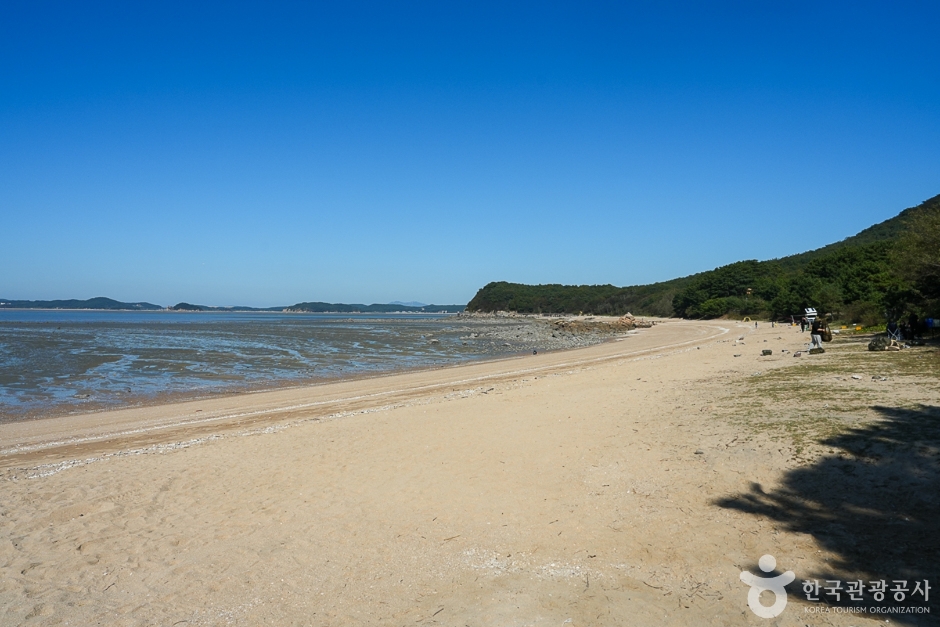 Silmi Beach & the tidal sandbar
Why go: A crescent of sand on Muuido's northwest shore, backed by a thick old pine forest that throws shade even at midday. Its party trick: at low tide a sandy path opens across the water to the islet just offshore — time your visit right and you can walk where the sea was an hour before.
 Sorae Port fish market & mudflats
Why go: A bustling fishing port and seafood market on the city's southern edge — wide mudflats, fishing boats, and a waterfront plaza where you can climb the shrimp-tower lookout. Come late, buy whatever's fresh off the boat, and stay for one of the best sunsets in the city.
Want to go bigger and older? Ganghwa Island (강화도), reached by bridge to the northwest, is a history lesson in island form — home to a cluster of prehistoric dolmens (고인돌) that are part of a UNESCO World Heritage listing, along with mountain fortresses and one of Korea's most storied temples. It's the kind of place that rewards a slower, separate day. And whenever the tide is low along this coast, the tidal flats (갯벌) themselves are the attraction: barefoot in the soft mud, crabs scattering, the West Sea pulled back to the horizon. It's a quieter, muddier kind of Korea than the postcards show — and it's right here, an hour from Seoul.
One last note on where you probably arrived: Incheon International Airport sits on the island of Yeongjong, just off the coast. If you've got hours to kill on a layover, it's worth knowing that the islands, Wolmido, and Chinatown are all an easy taxi or train ride away — Incheon makes a genuinely good first or last day in Korea, not just a place to change planes.
Half-day & full-day flows
Two ways to do it: a tight half-day if Incheon is a side trip from Seoul (or a layover with time to spare), or a full day if you want the old port, the future city, and the coast all in one go. Both are built to end on the water at sunset.
Half dayOld port, noodles & waterfront
- Late morning — Subway out from Seoul to Chinatown; walk the gate and the mural staircase.
- Lunch — Jjajangmyeon in Chinatown, then a wander up to Songwol-dong Fairy Tale Village.
- Afternoon — Stroll the Open Port district and Sinpo Market for dak-gangjeong.
- Sunset — Over to Wolmido for the lighthouse walk and the West Sea sundown.
Full dayPort to future city to coast
- Morning — Chinatown, Fairy Tale Village, and the Open Port streets; jjajangmyeon for lunch.
- Midday — Subway to Songdo: Central Park canal by water taxi, then the G Tower view.
- Afternoon — Out to the islands — Muuido's coastal trail and Silmi Beach at low tide.
- Evening — Fresh seafood and sunset at Sorae Port, or back to Wolmido for the waterfront.
Quick questions
Photo credits: Incheon Chinatown — Mobius6, CC BY-SA 4.0; Songwol-dong Fairy Tale Village — Helenakfronczak, CC BY-SA 4.0, both via Wikimedia Commons. All other photos © Korea Tourism Organization.
More from Incheon
Book Incheon tours & passes
Skip-the-line tours, day trips & transit passes — booked in English.
Affiliate placeholder · We may earn a commission, at no extra cost to you.