Gyeongju: Korea's Roofless Museum of the Silla Dynasty
A thousand years as Silla's capital left Gyeongju scattered with UNESCO temples, royal tombs and stone carvings — here's how to see the "museum without walls" in a couple of unhurried days.

Book Gyeongju tours & tickets
Skip-the-line tours, day trips & transit passes — booked in English.
Affiliate link · We may earn a commission, at no extra cost to you.Ask a K-drama fan where the past feels most alive in Korea, and increasingly the answer is Gyeongju — not Seoul. For nearly a thousand years this quiet city in Gyeongbuk was Seorabeol, capital of the Silla kingdom, and it never quite let go of that history. Ordinary streets dead-end into UNESCO temples; a city park turns out to be a cluster of royal tombs; a pond built for royal banquets still throws its lantern-light across the water after dark, just as it did in the seventh century. Locals call it "the museum without walls," and it's not an exaggeration — you can't dig far here without hitting another Silla-era relic, so Gyeongju has no subway, and the past simply stays where it fell.
This guide moves through the city the way most travelers actually experience it: the two great Buddhist monuments up in the hills, the walkable historic core of tombs and palaces that turns magical after sunset, an entire mountain scattered with centuries-old stone carvings, a hanok village standing shoulder to shoulder with its coffee-shop-lined modern cousin, and a stretch of coast where a Silla king is said to still watch over the sea. None of it needs more than a couple of unhurried days, and almost all of it is easy to reach without a car.
Silla's Twin Wonders of Buddhist Art
High on the slopes of Mount Tohamsan sit the two monuments that, more than any other, explain why UNESCO placed Gyeongju on the World Heritage list in 1995. Both are traditionally dated to the mid-8th century, credited to the Silla statesman Kim Dae-seong, and both reward the short uphill effort it takes to reach them.
 Bulguksa Temple
Why go: A terraced complex of wooden halls, stone bridges and twin pagodas — the plain Seokgatap and the ornate Dabotap — built to represent a Buddhist paradise on earth. Come early to see the courtyards before the tour buses arrive.
 Seokguram Grotto
Why go: A domed granite grotto holding a serene seated Buddha, positioned to gaze out toward the East Sea at sunrise. The statue now sits behind protective glass, but the hush of the chamber still stops most visitors mid-sentence.
The two sites share a single ticket and a shuttle bus, so most visitors do them back to back — Bulguksa first for its gardens and pagodas, then a short ride up to Seokguram for the view and the grotto. Photography inside the grotto itself isn't permitted, so let the walk up through the pine forest be the part you remember with your camera.
The Ancient Heart, by Day and by Night
Downtown Gyeongju is itself a UNESCO World Heritage Area — clusters of Silla-era remains woven through the modern city, inscribed in 2000. You can walk most of it in an afternoon, and it transforms again after dark, when lanterns replace daylight as the reason to come back.
 Cheomseongdae Observatory
Why go: Built during the reign of Queen Seondeok in the 7th century, this squat stone tower is believed to be the oldest surviving astronomical observatory in East Asia — 362 stones for the days of the lunar year, stacked in 27 rings for Seondeok as Silla's 27th ruler.
 Daereungwon & Cheonmachong
Why go: A quiet park of grass-covered burial mounds right in the city center. One tomb, Cheonmachong, is open to walk inside; it's named for a painting of a galloping heavenly horse found among its treasures, alongside one of Silla's dazzling gold crowns.
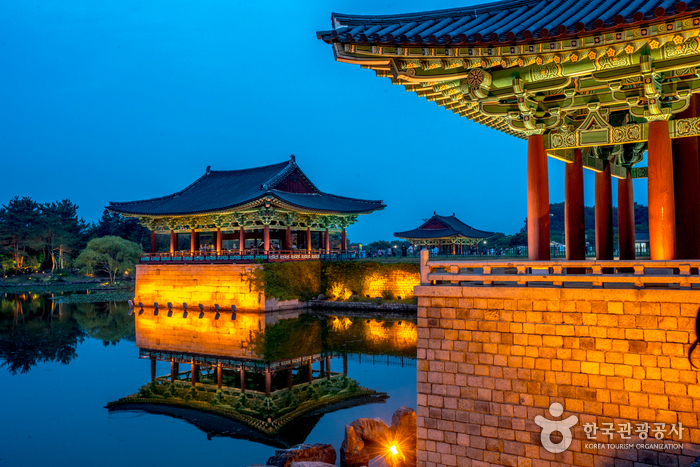 Donggung Palace & Wolji Pond
Why go: Once the crown prince's residence and banquet hall, dug for King Munmu in 674, as Silla completed its unification of the peninsula. By day it's a pleasant pond garden; after dark its reconstructed pavilions glow gold and double themselves in the still water — arguably Gyeongju's single best photo.
A five-minute walk from the pond, the wooden Woljeonggyo Bridge — a modern reconstruction of the span that once linked the royal palace at Wolseong to Namsan — lights up the same way after sunset, arched and lantern-lit over the Namcheon stream. Pair the two for an evening walk that needs no ticket beyond Wolji's small admission fee.
Namsan: The Mountain That Is a Museum
South of the old palace grounds rises Namsan, a low granite mountain laced with hiking trails — and scattered across its ridges, by most counts, well over a hundred Buddhist rock carvings, pagodas and temple sites dating back over a thousand years. Historians sometimes call it an open-air museum, and for once the label undersells it: nowhere else in Korea packs this much devotional stone art into a single afternoon hike.
 Baedong Samneung
Why go: Three grass-mounded tombs, believed to hold early Silla kings, set in a hush of tall red pine at the foot of Namsan — a favorite quiet-morning stop before the mountain trails get busy.
 Namsan-dong Stone Pagodas
Why go: A rare pair of three-story stone pagodas standing side by side, one plain and one ornately carved — a small puzzle of Silla stonework historians still discuss.
Full Namsan hikes can run half a day or longer, weaving past cliffside Buddha reliefs and abandoned temple foundations; if you only have an hour, the Samneung trailhead is the easiest way to sample the mountain's carved-stone atmosphere without committing to a summit.
Where Hanok Alleys Meet Modern Cafés
Just outside Daereungwon's tomb mounds, two very different versions of old Gyeongju sit almost across the street from each other — one dressed up for photos, the other still living quietly as it has for generations.
 Hwangridan-gil
Why go: A former residential lane turned strip of hanok-roofed cafes, dessert shops and independent boutiques, its low-slung tiled rooftops framed against the burial mounds behind them — Gyeongju's most photographed street, best walked slowly after an early dinner.
 Gyochon Hanok Village
Why go: A working village of tiled hanok houses beside the old Wolseong palace site, long home to the Gyeongju Choi clan — remembered in local lore for generations of quiet generosity toward their neighbors — and still home to breweries producing the local Gyodong beopju rice wine.
The two sit close enough to cover on foot in an evening: browse Hwangridan-gil's newer shopfronts, then slip a few streets over to Gyochon's quieter lanes, where laundry still dries in courtyards and the crowds thin out fast.
East to the Sea: King Munmu's Underwater Tomb
Gyeongju isn't only about the inland palace district — drive around 40 minutes east and the old Silla capital meets the open ocean at Gampo, near a beach with one of Korea's more haunting legends attached to it.
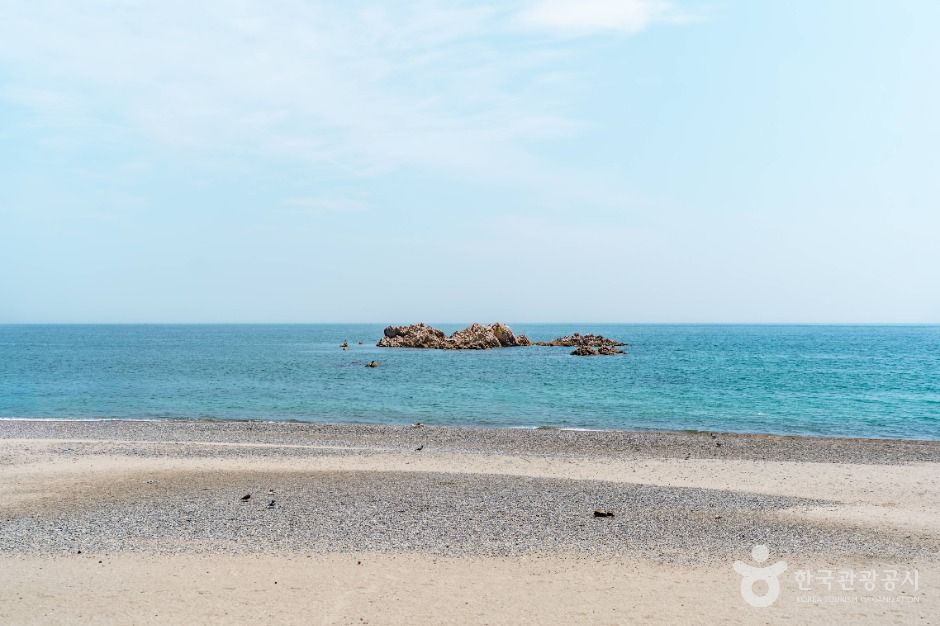 Bonggil Beach & Daewangam
Why go: A modest, uncrowded stretch of sand facing a jagged rock outcrop just offshore — said, according to Silla-era chronicles, to be the underwater resting place of King Munmu, who reportedly asked to be laid to rest beneath the sea so he could return as a dragon and guard the kingdom forever. Historians still debate the tomb's exact nature, but the view at dawn, when the rising sun frames the rock, needs no footnote.
Nearby Gampo's harbor town makes a good lunch stop before heading back inland — freshly caught seafood and a slower pace than downtown Gyeongju.
Bomun Lake & the National Museum
If you have a third day, or simply want to slow down between historic sites, two more stops round out the picture: a resort lake built for leisurely strolls, and the museum that finally explains everything you've just seen.
 Bomunjeong Pavilion
Why go: An octagonal pavilion on the shore of Lake Bomun, ringed with cherry and maple trees that make it a rotating showpiece across the seasons — photogenic enough to feature regularly on Korea's scenic-spot roundups.
 National Gyeongju Museum
Why go: Home to the treasures pulled from the tombs you've just walked past — gold crowns, ornaments, and the deep, resonant Divine Bell of King Seongdeok, cast in the 8th century and still one of the largest bronze bells to survive from ancient East Asia.
A Two-Day Flow
A gentle route that pairs a downtown day with a temples-and-coast day. Slow it down to three if you want Bomun Lake and the museum too.
Day 1Downtown by day, downtown by night
- Morning — Cheomseongdae Observatory, then a walk through the burial mounds of Daereungwon to Cheonmachong.
- Midday — Lunch and café-hopping along Hwangridan-gil.
- Afternoon — A few streets over to Gyochon Village for quiet hanok lanes and a taste of local Gyodong beopju.
- Evening — Donggung Palace & Wolji Pond at dusk, then the lantern-lit Woljeonggyo Bridge.
Day 2Temples, Namsan & the east coast
- Morning — Bulguksa Temple, then the shuttle bus up to Seokguram Grotto.
- Midday — Baedong Samneung and the Namsan-dong stone pagodas at the foot of Namsan.
- Afternoon — Drive east to Bonggil Beach and Daewangam for King Munmu's sea tomb.
- Evening — Seafood in Gampo's harbor town, or loop back to Bomunjeong for a lakeside sunset.
Getting Around Gyeongju
Gyeongju is compact enough that you rarely need a car for the historic core, but the outlying sites do call for some planning.
- By KTX: Gyeongju Station (renamed from Singyeongju Station in December 2023) is the high-speed rail gateway, roughly two hours from Seoul, with onward city buses (about 15–20 minutes) into the historic downtown.
- By regional train: The same station also handles Donghae line services, so connections from Busan and Pohang arrive there too — the old downtown Gyeongju Station closed in 2021 and no longer takes passengers.
- Within downtown: Cheomseongdae, Daereungwon, Donggung & Wolji, Woljeonggyo and Hwangridan-gil are all an easy, flat walk of each other, and rental bicycles are a popular, breezy way to link them.
- Out to the hills and coast: Bulguksa, Seokguram and Namsan sit outside the walkable core, and Bonggil Beach further still — local buses reach all of them, but a taxi or short rental car saves real time if you're short on days.
Before you go
Spring (cherry blossoms around Bomun and Daereungwon) and autumn (maple color on Namsan) are the two sweet spots for weather and photos, though Gyeongju is pleasant nearly year-round. If you only have one day, walk the downtown loop — Cheomseongdae, Daereungwon, Wolji, Hwangridan-gil — and save Bulguksa, Seokguram and the coast for a second. Wear shoes you don't mind getting dusty on Namsan's dirt trails, and if photographing Wolji or Woljeonggyo is a priority, go right after sunset rather than late at night — the last blue light in the sky makes the reflections even better.